
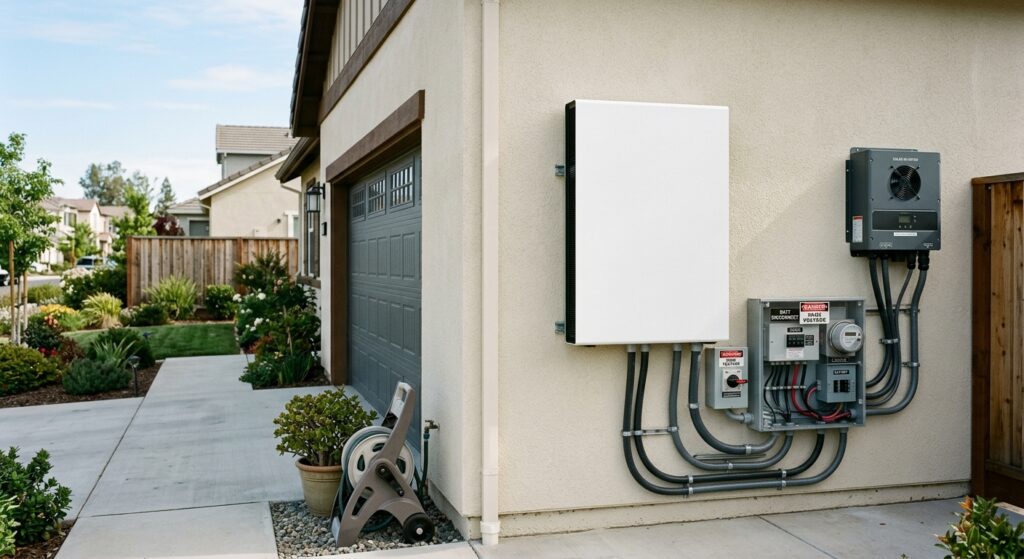
When the grid goes down, home battery backup systems have become one of the most popular ways to keep the lights on. Unlike a generator, a home battery stores energy in advance. It then releases that energy instantly and silently the moment power is lost. For homeowners comparing their options, it helps to understand how these systems work, what they cost, and which models stand out.
What Makes a Good Home Battery Backup System?
Not all batteries are created equal. First, look at usable capacity, measured in kWh. This tells you how much energy the battery can actually deliver. Second, check the continuous power output, measured in kW. This number tells you how many appliances the battery can run at once. For example, a battery with high capacity but low output can still trip if you run an AC unit and a fridge together. Third, consider solar compatibility. As a result, a solar-compatible battery can recharge itself during a multi-day outage instead of running dry. Finally, look at stackability, since many systems let you link several units together as your budget grows.
Tesla Powerwall: The Benchmark for Home Battery Backup Systems
The Tesla Powerwall 3 is the name most homeowners recognize first. It offers 13.5 kWh of usable capacity per unit. It also delivers up to 11.5 kW of continuous output. In addition, it includes a built-in solar inverter, which simplifies installation for homes pairing it with solar panels. Because of this, multiple Powerwalls can be stacked together for larger homes or longer outage coverage. However, the trade-off is price. Specifically, installed cost typically runs well above $10,000 per unit before incentives, and installation requires a licensed electrician, much like a standby generator setup.
Top Alternatives to Tesla Powerwall
Tesla is not the only serious option on the market. For instance, the Generac PWRcell is a strong choice for homeowners already considering a Generac standby generator, since the two systems integrate cleanly. Its modular design lets you scale capacity from 9 kWh up to nearly 18 kWh. Meanwhile, the EcoFlow Delta Pro is portable and does not need to be hardwired, which makes it easier to install or even move. As a result, it appeals to renters or anyone who wants flexibility. Similarly, the Bluetti AC300 paired with a B300 battery is modular and expandable, so homeowners can start small and add capacity over time. Finally, the Anker SOLIX F3800 is a newer entrant with fast recharge speeds and strong app-based monitoring. Overall, it competes well with Tesla on raw output.
Each of these alternatives targets a different budget and installation style. Therefore, the best choice depends less on brand reputation and more on how much power you actually need.
Battery Backup vs. Traditional Generators
Homeowners weighing a battery against a fuel-powered generator should think carefully about runtime. On one hand, a generator can run indefinitely as long as fuel is available. On the other hand, most home battery backup systems are built for shorter, essential-circuit backup. Typically, this means 8 to 24 hours, though it can be longer when paired with solar. For a deeper comparison of the two approaches, see our guide on solar generators vs. gas generators for home backup, which explains which option fits different outage patterns.
How to Choose Between These Home Battery Backup Systems
To start, list the circuits you actually need to keep running. Common examples include a refrigerator, a well pump, medical equipment, and a few outlets and lights. Next, add up their wattage. Then, match that number against the continuous output rating of each system, not just its total capacity. For homeowners in areas with frequent short outages, a single Powerwall or PWRcell unit is often enough. Meanwhile, homeowners in regions prone to multi-day outages should prioritize solar compatibility, since this lets the battery recharge without the grid. For a full cost breakdown across brands and sizes, our article on how much a home battery backup system costs walks through real installed pricing.
If your home already has solar panels, or if you are planning to add them, pairing them with a battery from this list is one of the most future-proof ways to prepare for outages. In that case, see our full roundup of the best solar generators for home backup power for portable options that complement a fixed battery system.
According to the U.S. Department of Energy, home battery storage systems are increasingly common alongside residential solar installations. In fact, homeowners often use them both for backup power and for reducing peak-hour electricity costs. In short, whether you choose a Powerwall or one of its rivals, a well-sized home battery backup system can turn a stressful outage into a minor inconvenience.
Incentives and Rebates to Consider
Before buying, it is worth checking what incentives apply in your state. For example, the federal Residential Clean Energy Credit can cover up to 30% of the cost of a battery paired with solar. In addition, many utilities offer their own rebates for battery storage, especially in states with frequent grid strain. As a result, the real cost of a home battery backup system is often lower than the sticker price suggests. Therefore, it pays to research local programs before comparing quotes from installers.
Frequently Asked Questions
How long does a home battery backup system last during an outage? It depends on the model and your energy use, but most systems power essential circuits for 8 to 24 hours. However, pairing the battery with solar panels can extend that window significantly.
Can you install a home battery backup system yourself? In most cases, no. Because these systems connect directly to your home’s electrical panel, installation typically requires a licensed electrician, similar to a standby generator.
Is a home battery backup system worth it compared to a generator? For homeowners who want silent, fume-free backup for short outages, yes. However, for multi-day outages without solar, a fuel-powered generator often remains the more practical choice.