
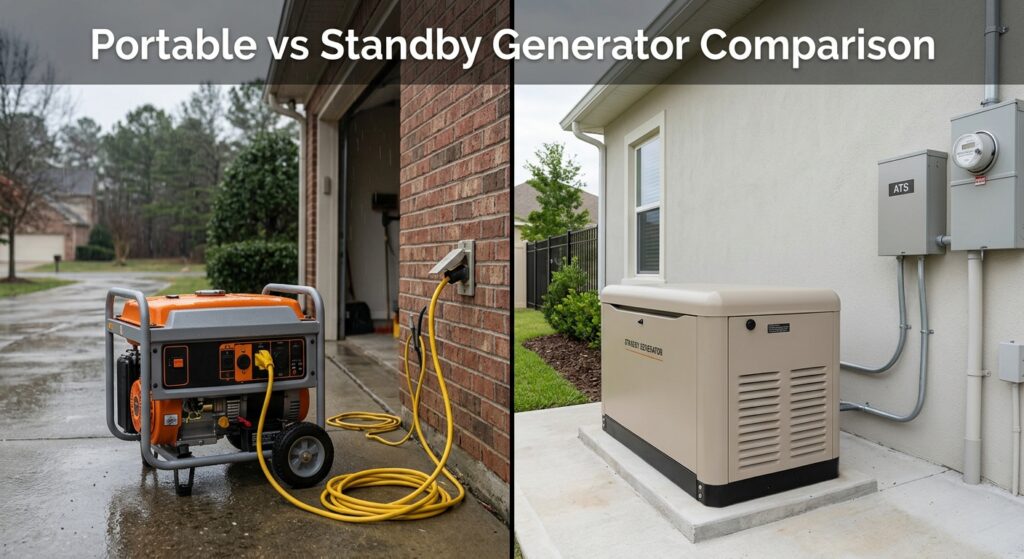
When the power goes out, the first real decision homeowners face isn’t which brand to buy — it’s which type of generator actually fits their situation. Portable generators and standby generators solve the same problem, keeping your home running during an outage, but they do it in completely different ways, at completely different price points, and for completely different kinds of homeowners.
Most comparison articles stop at “portable is cheaper, standby is more convenient.” That’s true, but it leaves out the details that actually determine whether you’ll be happy with your choice two years from now: hidden costs, how each option performs in specific real-world outage scenarios, and the mistakes homeowners make when they choose based on price alone.
Quick Answer
If you need occasional backup for a handful of essentials and want to keep upfront cost low, a portable generator is usually the right choice. If you live somewhere with frequent or extended outages, want your whole house covered automatically, and can invest more upfront, a standby generator is the better long-term fit.
What Is a Portable Generator?
A portable generator is a gas-, propane-, or dual-fuel-powered unit that sits outside your home and connects to appliances either directly with extension cords or, better, through a manual transfer switch wired to selected circuits. You start it manually when the power goes out and refuel it by hand throughout the outage.
- Typical output: 3,000–10,000 watts
- Typical price: $500–$2,000
- Setup: no permanent installation required (though a transfer switch is strongly recommended)
- Runtime: limited by fuel tank size, usually 8–12 hours per tank
What Is a Standby Generator?
A standby generator is permanently installed outside the home, wired directly into the electrical panel through an automatic transfer switch, and connected to natural gas or a large propane tank. When the power goes out, it detects the outage and starts itself within seconds, with no action required from you.
- Typical output: 10,000–22,000+ watts
- Typical price: $3,000–$10,000 for the unit, plus $3,000–$5,000 for professional installation
- Setup: requires a licensed electrician and often a permit
- Runtime: effectively unlimited when connected to natural gas
Side-by-Side Comparison
| Factor | Portable Generator | Standby Generator |
|---|---|---|
| Upfront cost | $500 – $2,000 | $6,000 – $15,000 installed |
| Startup | Manual, during the outage | Automatic, within seconds |
| Coverage | Select circuits/appliances | Whole house (sized to load) |
| Fuel | Gasoline, propane, refuel by hand | Natural gas or large propane tank |
| Noise | 64–72 dB, noticeable | 60–68 dB, quieter, insulated enclosure |
| Installation | DIY-friendly | Licensed electrician + permit required |
| Maintenance | Low, seasonal | Scheduled self-tests, annual service |
The Hidden Costs Nobody Mentions
Sticker price is misleading on both sides. Here’s what actually gets added on:
Portable generator hidden costs:
- Manual transfer switch installation: $400–$900 (skipping this and running extension cords through windows is both inefficient and a safety hazard)
- Heavy-duty outdoor extension cords rated for generator use: $50–$150 each
- CO detector upgrades for safe operation: $30–$60
- Fuel stabilizer and storage containers if you keep gasoline on hand: $50–$100/year
Standby generator hidden costs:
- Concrete or composite pad required by code in most jurisdictions: $200–$500
- Gas line upsizing if your existing line can’t support the generator’s demand: $500–$2,000
- Permit and inspection fees: $100–$500 depending on municipality
- Annual maintenance contract (oil, filters, battery, professional inspection): $150–$300/year
- Extended warranty, often recommended given the unit runs weekly self-tests year-round: $300–$600 for 5 years
A “$3,000 standby generator” frequently lands closer to $8,000–$10,000 once installation and site prep are included. Budgeting for these extras up front avoids an unpleasant surprise mid-project.
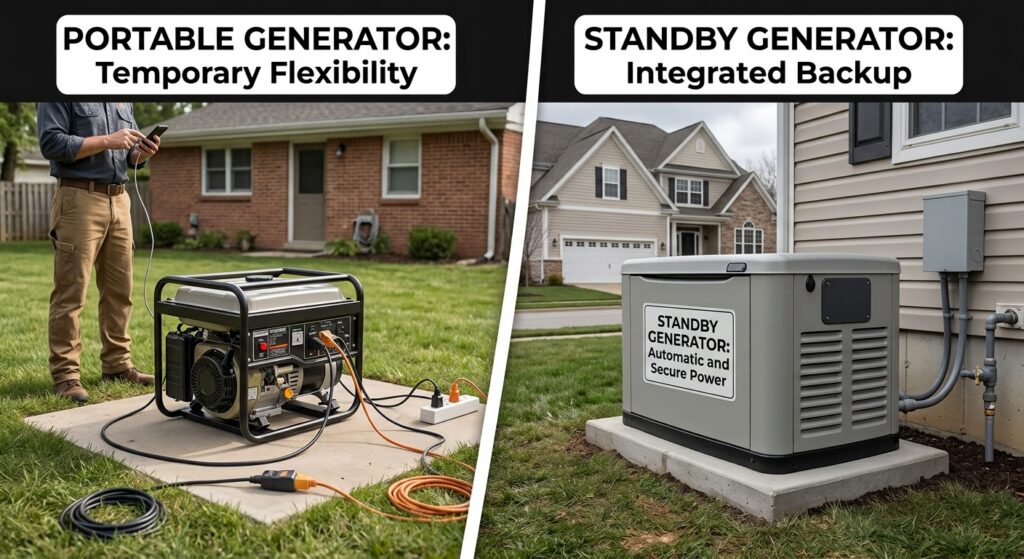
How Each Option Performs in Real Outage Scenarios
Scenario 1 — A 4-hour evening outage from a summer thunderstorm. A portable generator covering the fridge, some lights, and Wi-Fi is more than enough. A standby system is overkill here, though its owners won’t even notice the outage happened.
Scenario 2 — A 3-day outage after a hurricane. This is where portable generators show their real limitation: you’d need to wake up every 8–12 hours to refuel, in the middle of storm conditions, and store enough gasoline safely (most fire codes cap stored gasoline at 25 gallons). A standby generator connected to natural gas simply keeps running without intervention.
Scenario 3 — A week-long ice storm outage while you’re away at work. A portable generator does nothing if no one is home to start it. A standby generator detects the outage and starts automatically, protecting pipes from freezing and keeping the sump pump running whether you’re there or not.
Scenario 4 — Someone in the household depends on a CPAP machine, home dialysis, or refrigerated medication. Reliability without human intervention is the deciding factor here, and it pushes strongly toward a standby system regardless of budget, since a missed manual startup during a nighttime outage carries real health risk.
5 Mistakes Homeowners Make When Choosing Between the Two
- Buying a portable generator that’s technically powerful enough but ignoring starting watts. Appliances like refrigerators and well pumps need 2–3x their running wattage just to start. A generator rated for your total running watts can still stall trying to start a single appliance.
- Skipping the transfer switch to save money. Backfeeding power through a dryer outlet is illegal in most jurisdictions and can electrocute utility workers restoring the line. It’s the single most dangerous shortcut in this niche.
- Undersizing a standby generator to cut cost. A standby unit sized only for “essentials” defeats much of its own advantage — most homeowners regret not sizing for central AC and the kitchen once they see how little it adds to the monthly cost.
- Assuming natural gas means the generator will always run. In a severe enough event, gas utilities can also fail. It’s rare, but propane offers a self-contained alternative worth considering in disaster-prone regions.
- Not testing the system before an outage actually happens. Portable generators that sat unused for a year frequently won’t start when needed due to stale fuel; standby systems that skip their weekly self-test can fail silently. Both require a few minutes of routine attention.
Which One Fits Your Situation?
Choose a portable generator if:
- You experience occasional, short outages (a few times a year)
- You want to cover essentials only: fridge, some lights, Wi-Fi, a window AC unit
- You have a limited budget and want flexibility (you can take it camping or to a job site too)
- You’re comfortable manually starting and refueling equipment during a storm
Choose a standby generator if:
- You live in an area with frequent or multi-day outages (hurricane- or ice-storm-prone regions)
- You work from home or have medical equipment that can’t tolerate downtime
- You want the whole house powered automatically, even when you’re not home
- You can budget for a larger upfront investment in exchange for near-zero effort
Can You Start with a Portable and Upgrade Later?
Yes, and it’s a common path. Many homeowners start with a portable generator and a manual transfer switch to cover the basics affordably, then upgrade to a standby system once they’ve confirmed how often outages actually affect them and how much whole-house coverage is worth to their household. If you go this route, keep the portable unit afterward — it’s still useful as backup for the standby system during rare gas-supply disruptions, or for uses outside the home.
Frequently Asked Questions
Is a standby generator worth the extra cost?
For homeowners in outage-prone regions or with critical needs like medical equipment or a home office, most find the automatic coverage worth the premium. For occasional, short outages, a portable generator delivers most of the benefit at a fraction of the cost.
Can a portable generator power a whole house?
Only a large portable unit (10,000+ watts) paired with a properly sized transfer switch can cover most essential circuits, but it typically can’t run high-draw appliances like central AC and an electric water heater at the same time.
Do standby generators run on their own even when no one is home?
Yes. That automatic detection and startup is the core advantage of a standby system over a portable one.
How long does a standby generator installation take?
Typically 1–3 days of on-site work, though permitting and gas company scheduling can stretch the total timeline to 2–6 weeks depending on the municipality.
Bottom Line
There’s no universally “better” option — only the one that matches your outage frequency, budget, and tolerance for manual effort. Use the comparison above, run your own numbers against the hidden-cost breakdown, and check our detailed guides on choosing generator size and on installation and transfer switches before making a final decision.