
Buying a generator that’s too small leaves you in the dark when it matters most. Buying one that’s too big means paying hundreds of dollars more than you needed to, plus higher fuel costs for the life of the machine. The good news: sizing a generator correctly isn’t guesswork. It comes down to four numbers you can calculate yourself in about fifteen minutes.
This guide walks through exactly how to do that, using the same method electricians and generator dealers use, so you can shop with a real wattage target instead of a vague “medium size” recommendation.
Why Generator Sizing Matters More Than the Price Tag
Every generator is rated in watts, not in “small/medium/large.” Two numbers matter on the box or spec sheet:
- Running watts (rated watts): the continuous power the generator can supply once everything is up and running.
- Starting watts (surge watts): a short burst of extra power, usually available for a few seconds, needed to start motors — refrigerator compressors, well pumps, air conditioners, and power tools all draw a spike of power the instant they switch on, sometimes 2-3 times their running wattage.
If a generator’s running watts can’t cover your total load, breakers will trip or the unit will stall. If its starting watts can’t cover the single largest surge on your list, the motor that’s trying to start will fail to turn on — even if the generator handles everything else fine. Sizing correctly means checking both numbers, not just one.
Step 1: List What You Actually Want to Power
Don’t try to run your entire house on generator power unless you’re installing a whole-house standby unit — most portable and mid-size setups are built to cover the essentials during an outage. Walk through your home and write down what you’d realistically want running:
- Refrigerator and/or freezer
- Sump pump or well pump (if applicable)
- Furnace blower or portable space heater
- A window or portable air conditioner
- Lighting circuits
- Phone/laptop chargers, Wi-Fi router, TV
- Microwave
Separate “must-run” items from “nice-to-have” items. This list is what everything else in this guide is built around.
Step 2: Find the Running and Starting Watts for Each Item
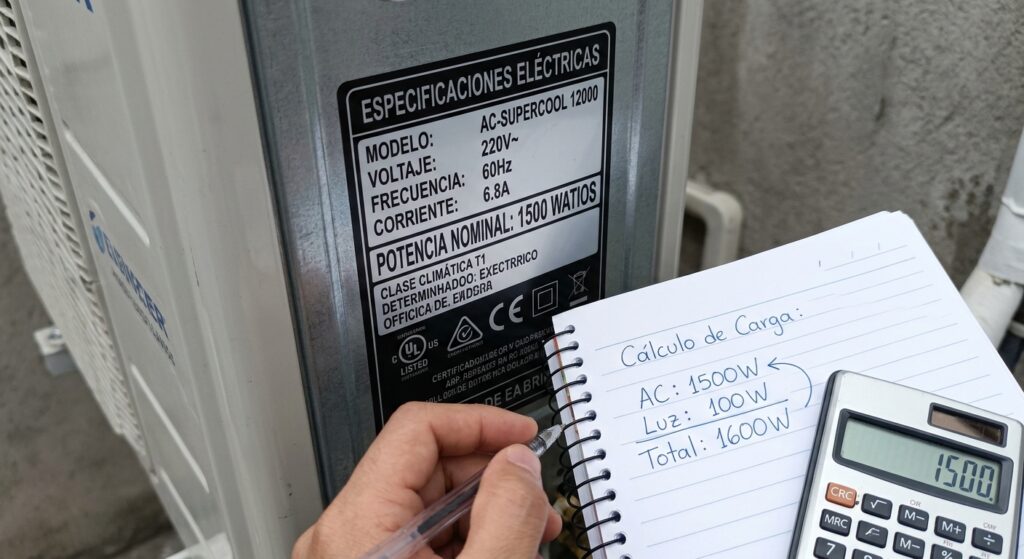
The most accurate numbers come from the appliance’s own nameplate or owner’s manual — look for a sticker on the back or bottom listing watts, or amps and volts (watts = amps × volts). When you can’t check a specific unit, the ranges below are typical for U.S. residential appliances and are a reliable starting point for planning.
| Appliance | Running Watts | Starting Watts |
|---|---|---|
| Refrigerator (standard) | 700 – 1,200 | 1,800 – 3,000 |
| Chest freezer | 500 – 800 | 1,500 – 2,200 |
| Sump pump (1/3 – 1/2 HP) | 800 – 1,050 | 1,300 – 2,150 |
| Well pump (1/2 HP) | 1,000 – 2,000 | 2,000 – 3,000 |
| Furnace blower fan | 600 – 1,000 | 1,200 – 2,300 |
| Window AC unit (10,000 BTU) | 1,200 – 1,500 | 3,600 – 4,500 |
| Space heater (portable) | 1,200 – 1,500 | none (resistive load) |
| Microwave | 600 – 1,200 | none (resistive load) |
| General lighting (per LED bulb) | 8 – 15 | none |
| Laptop / phone charger | 30 – 70 | none |
| Wi-Fi router | 10 – 20 | none |
| 42″ LED TV | 80 – 120 | none |
These are the same categories of numbers you’ll see printed on the appliance itself — the table just saves you from having to track down ten different manuals before you start shopping.
Step 3: Add Up Running Watts, Then Find Your Single Largest Starting Watt
Two separate calculations, not one:
- Total running watts: add up the running watts of every item on your must-run list. This is the continuous load your generator needs to sustain.
- Largest single starting watts: look at the starting watts column and find the highest number among your motor-driven appliances (fridge, pump, AC — not lights or electronics, which don’t surge). You only add this one figure on top of your running total, because appliances rarely all start at the exact same instant, and a generator only needs enough surge capacity for the worst single moment.
Formula:
Minimum generator running watts needed = Total running watts + Largest single starting watts surplus
Where “starting watts surplus” is that appliance’s starting watts minus its own running watts (since its running watts are already counted in your total).
Step 4: Add a 10–20% Safety Buffer
Generators lose some output as they age, run hotter in summer, or sit at high altitude, all of which reduce effective capacity. A 10–20% buffer above your calculated minimum protects you from those real-world losses and leaves headroom to add one more device later without upgrading the whole unit.
Two Worked Examples
Example A — Apartment/small home, essentials only
Fridge (1,000W running / 2,200W starting) + sump pump (900W running / 1,800W starting) + 6 LED lights (90W) + Wi-Fi router (15W) + laptop charger (60W) + TV (100W).
- Total running watts: 1,000 + 900 + 90 + 15 + 60 + 100 = 2,165W
- Largest starting surplus: fridge starting (2,200) − fridge running (1,000) = 1,200W (this is larger than the pump’s own surplus of 900W)
- Minimum needed: 2,165 + 1,200 = 3,365W
- With a 15% buffer: ≈ 3,870W → a 4,000–4,500W portable or inverter generator comfortably covers this household.
Example B — Mid-size single-family home with a well
Fridge (1,100W/2,600W) + freezer (650W/1,900W) + well pump (1,500W/2,800W) + furnace blower (800W/1,900W) + window AC (1,400W/4,200W) + lighting/electronics (300W).
- Total running watts: 1,100 + 650 + 1,500 + 800 + 1,400 + 300 = 5,750W
- Largest starting surplus: window AC starting (4,200) − AC running (1,400) = 2,800W (larger than the well pump’s 1,300W surplus)
- Minimum needed: 5,750 + 2,800 = 8,550W
- With a 15% buffer: ≈ 9,830W → this household needs a 10,000W-class portable/towable unit, or is a strong candidate for a standby generator sized around 12–14 kW once future appliances are factored in.
Notice how similar-looking homes can land 6,000 watts apart depending on whether a well pump and central AC are involved — this is exactly why a generic “just get a 5,000W generator” recommendation fails so often.
Quick Reference: Typical Sizing by Situation
| Situation | Typical Wattage Range |
|---|---|
| Phones, lights, Wi-Fi, small fridge only | 2,000 – 3,000W |
| Fridge + sump pump + basic electronics | 3,000 – 4,500W |
| Fridge, freezer, furnace blower, some lighting | 5,000 – 7,000W |
| Adding a well pump or central AC | 7,500 – 10,000W |
| Whole-house standby coverage (most systems) | 10,000 – 26,000W (standby generators, not portables) |
Use this table only as a sanity check after you’ve done your own math in Steps 1–4 — every household’s real number depends on which specific appliances are on the list.
Common Sizing Mistakes to Avoid
- Ignoring starting watts entirely. A generator rated at 4,000 running watts might only offer 4,000–4,500 starting watts too, which isn’t enough if you’re trying to start a well pump on top of an already-running fridge.
- Assuming everything starts at once and adding all starting watts together. This wildly oversizes the generator and inflates the budget unnecessarily; only the single largest starting surplus needs to be added.
- Sizing off “average” household watts found online instead of your own appliance list. Two three-bedroom homes can have very different loads depending on whether they have a well, electric water heater, or central air.
- Skipping the safety buffer and buying exactly to the calculated minimum, leaving no room for altitude, heat, or a future appliance addition.
- Forgetting startup loads on non-appliance equipment, like garage door openers, table saws, or air compressors, if those are also on the must-run list.
Frequently Asked Questions
How many watts do I need to run a whole house?
Most single-family homes need somewhere between 5,000 and 12,000 running watts to cover the essential circuits (not every outlet in the house) during an outage. A true whole-house standby generator covering every circuit typically runs 16,000–26,000 watts, sized by a licensed installer based on your electrical panel.
Can I use a smaller generator if I rotate which appliances run at a time?
Yes. Load management — running the AC and the microwave at different times, for example — is a legitimate way to get by with a smaller, less expensive unit, as long as you’re comfortable manually managing what’s on.
Do I need to size for 100% of my appliances or just the essentials?
Just the essentials, unless you’re installing a whole-house standby system. Most portable and mid-size setups are designed to cover refrigeration, some lighting, communication devices, and one or two larger loads like a pump or furnace blower — not every outlet in the house.
What happens if my generator is undersized?
The generator will either trip its own breaker, stall under load, or fail to start the largest motor on the circuit. It won’t damage the generator in most cases, but it can shorten the life of the appliance trying to start on insufficient power.
Should I size for future appliances I might add?
It’s worth adding 500–1,000 extra watts of headroom if you’re planning to add central air, a well pump, or an EV charger setup in the next few years, since upgrading a generator later costs more than buying slightly bigger the first time.