
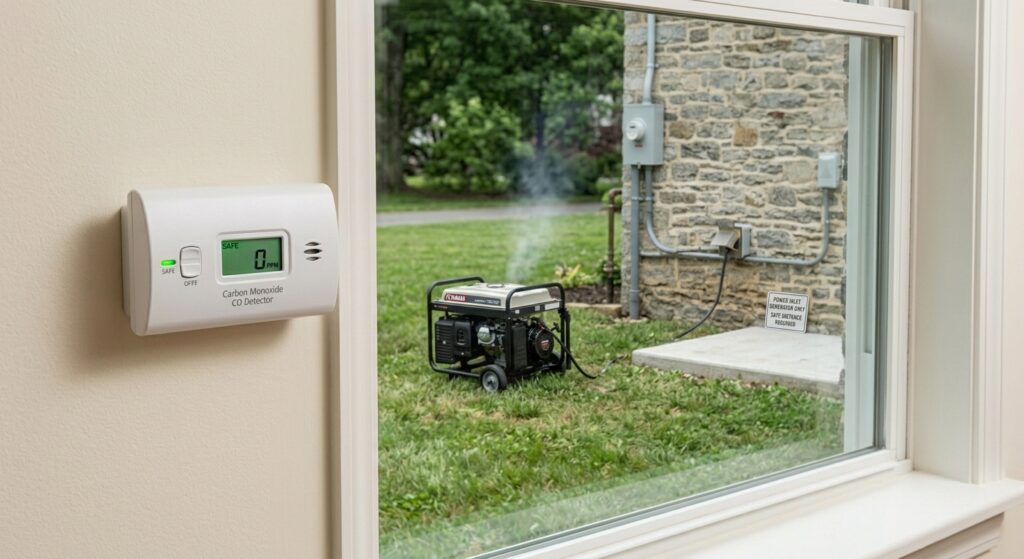
Every year, generator-related carbon monoxide poisoning sends people to emergency rooms, and some of these incidents are fatal. Carbon monoxide safety isn’t a footnote in the owner’s manual. Instead, it’s the single most important rule for anyone running a generator during a power outage. Carbon monoxide is colorless, odorless, and completely undetectable without a working alarm, which makes it far more dangerous than most people realize, especially during a stressful outage when normal precautions can slip. This guide covers exactly what puts you at risk, and the specific rules that prevent it.
Why Carbon Monoxide From Generators Is So Dangerous
Generators burn fuel to produce electricity, and that combustion process always creates carbon monoxide as a byproduct. In open air, this gas disperses quickly and poses little risk. However, in an enclosed or partially enclosed space, it can build up to lethal concentrations within minutes.
The danger comes from how carbon monoxide affects the body. Specifically, it binds to red blood cells far more readily than oxygen does, which effectively starves your organs and brain of oxygen even while you keep breathing normally. As a result, symptoms can mimic the flu, exhaustion, or simple dizziness. People often don’t realize what’s happening until they lose consciousness, and that’s exactly why an alarm matters more than any amount of personal awareness.
How Quickly Carbon Monoxide Becomes Dangerous
Understanding actual exposure levels helps explain why this hazard escalates so fast. Carbon monoxide concentration is measured in parts per million, or ppm. At around 70 ppm, healthy adults may start to experience mild headaches after a few hours of exposure. At 150–200 ppm, symptoms progress to intense headache, dizziness, and nausea within an hour or two. Meanwhile, at levels above 400 ppm, which a running generator can produce in an enclosed garage within minutes, confusion and loss of consciousness can follow in under an hour, with life-threatening effects soon after.
These numbers explain why a running generator in an attached garage is so much more dangerous than it might seem. A single generator can reach lethal concentrations in a garage-sized space in less time than it takes to notice something feels wrong.
Where You Can Never Run a Generator
This is the single rule that matters most: never run a generator inside an enclosed or partially enclosed space. That includes garages, even with the door open, along with basements, crawl spaces, sheds, porches, and carports.
An open garage door might feel like enough ventilation, but it isn’t. Carbon monoxide can accumulate to dangerous levels within an attached garage in a matter of minutes, and that gas doesn’t stay contained to the garage. Instead, it travels through doors, vents, and even small gaps into the living space of the home itself.
The Consumer Product Safety Commission specifically warns that generators should be operated only outdoors, far from any structure with windows or doors that could let exhaust drift inside.
Correct Placement for Outdoor Generator Use
Placing a generator outdoors isn’t automatically safe on its own, since distance and direction both matter. Most manufacturers and safety agencies recommend keeping a portable generator at least 20 feet from your home, pointing the exhaust away from windows, doors, and vents whenever possible.
Wind direction can also carry exhaust back toward a house even at a reasonable distance, so it’s worth checking which way the air is moving before deciding on a final placement, especially during a storm when wind patterns can shift quickly. Standby generators, which are permanently installed, are positioned by a professional according to manufacturer clearance specs precisely for this reason, since their placement has to account for prevailing wind patterns and nearby windows from the start.
Why “Quiet Enclosures” Don’t Make a Generator Safe Indoors
A common misconception is that a sound-dampening enclosure, sold to reduce generator noise, also makes it safe to run a unit in a partially enclosed space like a garage or breezeway. This isn’t true. Regardless of how quiet it runs, a generator inside any structure still produces the same volume of carbon monoxide, and that gas will still accumulate if airflow to open outdoor air is restricted.
The only enclosures that change this equation are ones specifically engineered and certified for exhaust ventilation, which is a different category of product entirely from a standard consumer noise-reduction cover.
Carbon Monoxide Auto-Shutoff Technology
In recent years, many manufacturers have added carbon monoxide sensors directly into portable generators, a feature increasingly required by law in several states following a wave of preventable deaths. These sensors detect rising CO concentrations near the unit and automatically shut the engine down before levels become dangerous, adding a layer of protection that works even if a generator ends up placed too close to a home by mistake.
Even so, this technology is a valuable backup rather than a substitute for correct placement, since it’s designed to catch a mistake rather than to make risky placement acceptable in the first place. When shopping for a new portable generator, checking whether it includes this auto-shutoff feature is worth the small amount of research it takes, particularly for anyone who might use the generator in a location with limited outdoor space.
Why You Need a Carbon Monoxide Detector, Not Just Caution
Following placement rules dramatically reduces risk, but it doesn’t eliminate the need for a working carbon monoxide detector inside your home, since detectors exist specifically because carbon monoxide gives no warning of its own. You cannot smell it, see it, or taste it building up in a room.
Every home running a generator during an outage should have a working CO detector on each level, particularly near bedrooms where a slow buildup overnight is most dangerous. Many modern models are designed specifically for generator use and can shut a unit down automatically if CO levels rise nearby, which adds a layer of protection beyond a simple alarm.
Recognizing the Early Symptoms
Even with good placement and a working detector, it’s worth knowing the early symptoms of carbon monoxide exposure, since alarms can occasionally fail or run on depleted batteries. Early signs include headache, dizziness, nausea, and unusual fatigue, and these symptoms often affect multiple people in a household around the same time, which is a strong warning sign that something environmental, rather than an individual illness, is the cause.
If anyone in the home shows these symptoms while a generator is running, the correct response is to get everyone outside into fresh air immediately, then call emergency services before trying to investigate the cause yourself.
Additional Safety Habits Worth Building
A few smaller habits add meaningful protection beyond placement and detectors. For instance, never run a generator in wet conditions without proper weather protection rated for that purpose, since this creates a separate electrocution risk alongside the carbon monoxide concern. Similarly, let a generator cool down fully before refueling it, since spilled fuel on a hot engine can ignite. Finally, test carbon monoxide detectors regularly, not just once when they’re installed, and replace batteries on a fixed schedule so a dead detector doesn’t sit unnoticed until it’s needed.
Final Thoughts
Carbon monoxide safety comes down to two layers of protection working together: correct outdoor placement, far from doors and windows, and a working detector inside the home as a backup for the invisible risk that placement alone can’t fully eliminate. Neither one replaces the other. As a result, skipping either step turns a routine outage into a genuine medical emergency, often without any warning until it’s too late to act.aces the other. Skipping either step turns a routine outage into a genuine medical emergency, often without any warning until it’s too late to act.