
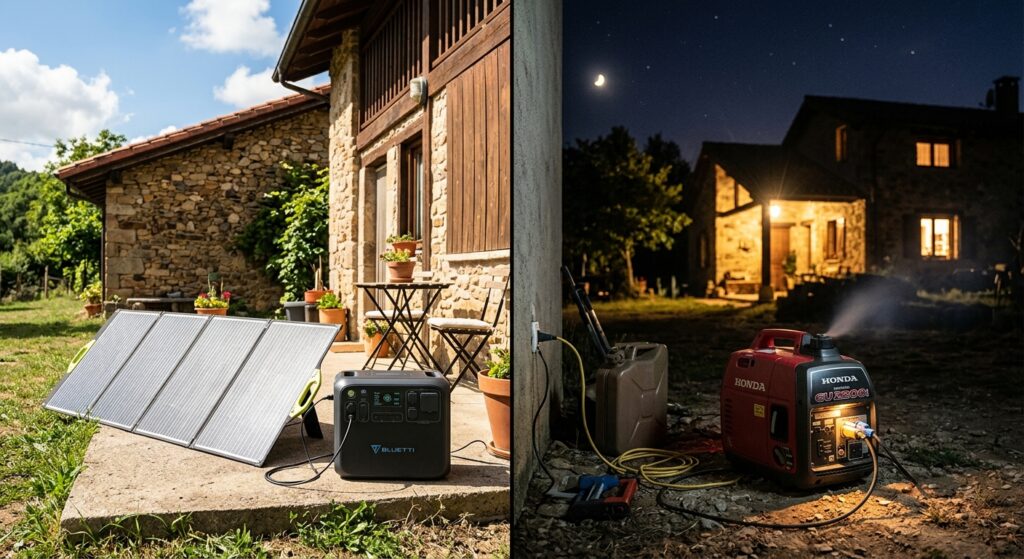
When the power goes out, one of the first decisions homeowners face is solar vs gas generators — and it’s not always an easy call. Gas generators have been the default choice for decades, while solar generators (battery-based power stations charged by solar panels) have become a serious alternative in recent years. Both can keep your fridge running, your phone charged, and your home comfortable during an outage, but they work very differently, and the right pick depends on your budget, how long outages typically last in your area, and how much power you actually need.
In this guide, we’ll break down the real differences between solar vs gas generators so you can make a decision that fits your household, not just a marketing claim.
Solar vs Gas Generators: How They Actually Work
A gas generator burns fuel (gasoline, propane, or diesel) to power an internal combustion engine that spins an alternator and produces electricity. It needs to be refueled regularly, must run outdoors due to carbon monoxide risk, and produces power for as long as you keep feeding it fuel.
A solar generator is essentially a large battery (“power station”) that stores energy and can be recharged by solar panels, a wall outlet, or sometimes a car charger. It has no engine, no exhaust, and no fuel to store — but its total output is limited by battery capacity, not an endless fuel supply. This stored-energy-versus-continuous-fuel difference is what drives almost every other trade-off below.
Cost Comparison
Upfront cost is usually where the conversation starts. A capable gas generator (5,000–7,500 watts) typically costs $500–$1,200, plus ongoing fuel costs. A solar generator with similar real-world output (2,000–3,000Wh battery capacity) often costs $1,500–$3,000 or more, since battery technology is more expensive than a small engine.
However, gas generators carry hidden long-term costs: fuel, oil changes, spark plugs, and eventual engine wear — typically $100–$200 per year even with light use. Solar generators have close to zero ongoing cost once purchased, since sunlight is free and there’s no engine to maintain. Over a 5–10 year period, the total cost gap narrows considerably, especially in regions with frequent, shorter outages where a solar unit gets recharged easily between storms.
Runtime and Power Capacity
This is where gas generators still have a clear edge. As long as you have fuel, a gas generator can run continuously for days, which matters if you’re facing an extended outage after a hurricane or major storm. Solar generators are limited by battery size: a mid-range unit might power a fridge, some lights, and small electronics for 1–2 days, but recharging fully via solar panels can take a full day of good sunlight — not guaranteed during storm season, when skies are often overcast.
For whole-home backup or running high-draw appliances like a well pump or central AC, gas (or standby) generators remain the more realistic option. Solar units tend to shine for shorter outages, RV/camping use, or as a quiet backup for essentials.
Lifespan and Warranty
Gas generators typically last 1,000–2,000 hours of run time before major engine work is needed, which for most households translates to 10–15 years of occasional outage use. Warranties usually run 2–3 years on the engine.
Solar generators are built around lithium battery cells, which degrade gradually with charge cycles rather than failing outright. Most quality units are rated for 500–3,000 charge cycles, often translating to 5–10 years of regular use, with warranties commonly ranging from 2–5 years depending on the brand. Neither technology “lasts forever,” so factoring replacement cost into your long-term budget is worth doing regardless of which side of the solar vs gas generators comparison you land on.
Noise, Safety, and Maintenance
Noise is a real quality-of-life factor. Gas generators typically run at 60–75 dB, loud enough to bother neighbors and to require placement well away from windows. Solar generators run silently, since there’s no engine — a meaningful advantage if you live in a neighborhood with noise restrictions or simply want to sleep through the outage.
Safety is another important difference. Gas generators produce carbon monoxide and must always run outdoors, away from windows and doors — a rule that, unfortunately, still causes preventable injuries and deaths every year when ignored. Solar generators produce no emissions and can safely be used indoors, making them a lower-risk option for families with children, pets, or anyone uncomfortable handling fuel storage.
A Real-World Example
Consider two neighboring households during a two-day winter outage. The one relying on a gas generator kept the furnace blower, fridge, and a few lights running the entire time, but had to brave icy roads twice to refuel. The one relying on a solar generator comfortably powered the fridge, Wi-Fi router, and phone charging for the first day, then had to ration usage on day two since cloud cover slowed the recharge. Neither approach was “wrong” — it simply reflected what each household prioritized: uninterrupted power versus quiet, fuel-free operation.
Which Is Better for Your Home?
There’s no single winner between solar vs gas generators — it depends on your outage pattern and needs:
- Choose a gas generator if you experience long outages (multiple days), need to power major appliances, or want the lowest upfront cost.
- Choose a solar generator if your outages are typically short, you want silent and emission-free operation, or you’d rather avoid storing and handling fuel.
- Consider both for a layered approach: a solar generator for daily essentials and quiet nighttime use, paired with a gas generator as backup for extended outages.
If you’re still narrowing down your first pick, our guide to the best solar generators for home backup power walks through specific models and capacities, and if a fuel-based option still makes sense for your household, our comparison of gas, propane, and diesel generators breaks down which fuel type fits different budgets and climates.
Whichever direction you choose, the U.S. Department of Energy’s overview of home backup power options is a useful independent resource for sizing your system correctly before you buy.
Frequently Asked Questions
Can a solar generator fully replace a gas generator? For short outages and essential circuits, often yes. For multi-day, whole-home backup, most households still lean on gas or standby power.
Do solar generators work on cloudy days? Yes, but recharge speed drops significantly, so a fully charged battery going into the outage matters more than relying on real-time solar input.
Bottom Line
Both options can keep your household running through an outage, but they solve different problems. Gas generators still win on raw runtime and power for whole-home needs, while solar generators win on safety, silence, and long-term cost once fuel is factored out. For most homeowners weighing solar vs gas generators, the deciding factor isn’t which is objectively “better” — it’s matching the generator type to how often and how long your power actually goes out.