
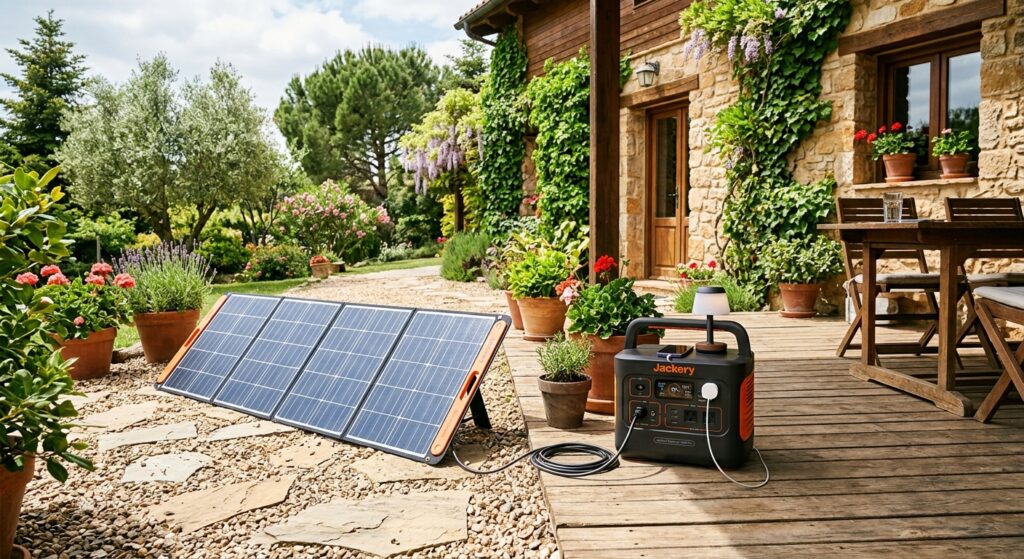
When the grid goes down, not everyone wants to deal with gasoline, extension cords through a window, or the noise of a traditional generator running all night. Fortunately, solar generators offer a quieter alternative. Unlike gas-powered units, a solar generator is really a battery with an inverter built in — one you can charge from a wall outlet ahead of a storm, or top up with solar panels during an extended outage. Below, we break down what actually matters when comparing solar generators for home backup power, along with the best options for different needs and budgets, and how to keep one ready for the next outage.
What a Solar Generator Actually Is
A solar generator, more accurately called a portable power station, stores energy in a battery — usually lithium iron phosphate — and delivers it through AC outlets, USB ports, and sometimes a car socket. It can be recharged from a wall outlet, a car, or solar panels sold separately or as a bundle.
These units are best suited for powering essentials during a short-to-medium outage: refrigerators, WiFi routers, phones, laptops, CPAP machines, lighting, and small appliances. However, they’re not designed to run a whole house or high-draw equipment like a central air conditioner or an electric water heater. For that level of backup, a whole-house standby generator is the better fit.
What to Look for When Comparing Options
Battery capacity, measured in watt-hours (Wh), determines how long a unit can run your devices. For example, a 500Wh unit might power a fridge for several hours, while a 2,000Wh+ unit can realistically get a household through a full day of essentials.
Continuous output and surge capacity matter just as much as capacity. Continuous watts tell you what the unit can power at once, while surge watts cover anything with a motor — a refrigerator compressor, for instance — which draws a short burst of extra power when it kicks on.
Recharge time also varies quite a bit between models. Some units recharge from a wall outlet in under two hours, whereas others take much longer. If you plan to pair the unit with solar panels, it’s worth checking the maximum solar input it accepts, since a mismatch between panel output and charge controller can leave you recharging far more slowly than expected.
Finally, expandability is worth checking too. Several newer models let you link additional battery packs to increase capacity later, so you can start smaller and scale up over time instead of buying the biggest unit up front.
Best Solar Generators for Home Backup Power
For most homes, a mid-size unit in the 1,500–2,000Wh range is the sweet spot. With at least 1,800W of continuous output, it covers the essentials — fridge, WiFi, lights, phone charging — for a full day or more, and recharges from a wall outlet overnight.
If you want whole-day backup for every essential, a larger 3,000Wh+ system with expansion battery support is worth the extra cost. It comfortably runs a fridge, a few lights, and charges multiple devices for 24+ hours without needing any sun at all.
On a tighter budget, a compact 300–500Wh power station still keeps phones, a router, and small lighting running through a shorter outage, at a fraction of the price of larger units.
And for anyone in a sunnier climate, pairing a mid-size unit with a foldable solar panel lets you keep recharging indefinitely during a multi-day outage, without relying on grid power or a car to top it back up.
Solar Generator vs. Gas Generator
Solar generators win on noise, since they run silently, and on safety, since there’s no carbon monoxide risk from using one indoors. They also carry zero ongoing fuel cost. Gas generators, on the other hand, win on raw power output and on how long they can run without recharging, which makes them better suited for whole-house backup or extended multi-day outages.
As a result, many households end up using both: a gas or standby unit for high-draw appliances, and a solar power station as a quiet, safe backup for essentials and overnight use. For a deeper side-by-side comparison, see our guide on solar generators vs. gas generators for home backup.
Keeping Your Solar Generator Ready
A power station only helps if it actually has charge when you need it. Once a month, top the battery back up to 100% and let it run a small load, like a lamp or a fan, for a few minutes to confirm the inverter is working correctly. Storing the unit at roughly 50-80% charge between uses, rather than always topping it off to full, also helps preserve battery lifespan. In addition, keep the unit somewhere dry and moderate in temperature — extreme heat or cold can reduce both capacity and how many charge cycles the battery has left.
How Much Should You Budget?
Entry-level power stations start under $300. Meanwhile, mid-size units capable of running a fridge for a day typically fall in the $800–$1,500 range, and larger, expandable systems with multiple battery packs can run $2,000–$4,000 or more. If cost is the main concern, our guide on the best portable power stations under $500 covers solid options at the lower end of that range.
Frequently Asked Questions
Can a solar generator power a refrigerator?
Yes, most mid-size and larger units can run a standard refrigerator for many hours on a single charge, as long as the unit’s continuous output covers the fridge’s running wattage plus its startup surge.
Do I need solar panels to use a solar generator?
Not necessarily. Solar panels are optional, since most units can be fully charged from a standard wall outlet. The panels simply extend how long you can keep the battery topped up without grid power.
How long do solar generator batteries last?
Most modern units use lithium iron phosphate batteries rated for 2,000–3,500 charge cycles. In practice, that typically translates to 8–10+ years of regular use before capacity noticeably declines.
Is a solar generator worth it if I already have a gas generator?
For many households, yes. A solar unit adds a quiet, indoor-safe way to keep essentials running overnight or during shorter outages, without needing to refuel or worry about fumes.