
Keeping food safe during a power outage without a generator comes down to timing and a few smart habits. Most households do not own a backup generator, yet food spoilage remains one of the most common and costly outage problems. Fortunately, a little preparation and the right response in the moment can protect most of what is in your kitchen.
The 4-Hour Refrigerator Rule
According to the USDA, a refrigerator keeps food safely cold for about 4 hours. This holds true as long as the door stays closed during the outage. Therefore, the single most important habit is simple: open the refrigerator as little as possible once the power goes out. Every open door lets cold air escape and shortens that window. If a storm is coming, chill items to their coldest setting in advance. A colder starting point buys extra time once power actually fails.
How Long a Full Freezer Stays Safe
A full freezer holds a safe temperature for roughly 48 hours if left unopened. A half-full freezer, by contrast, only lasts about 24 hours, since there is less frozen mass to hold the cold. Because of this, it helps to keep your freezer as full as possible year-round, even packing empty space with water bottles. This simple trick extends how long food stays safe during a power outage without a generator, at no extra cost.
Using Coolers and Ice Strategically
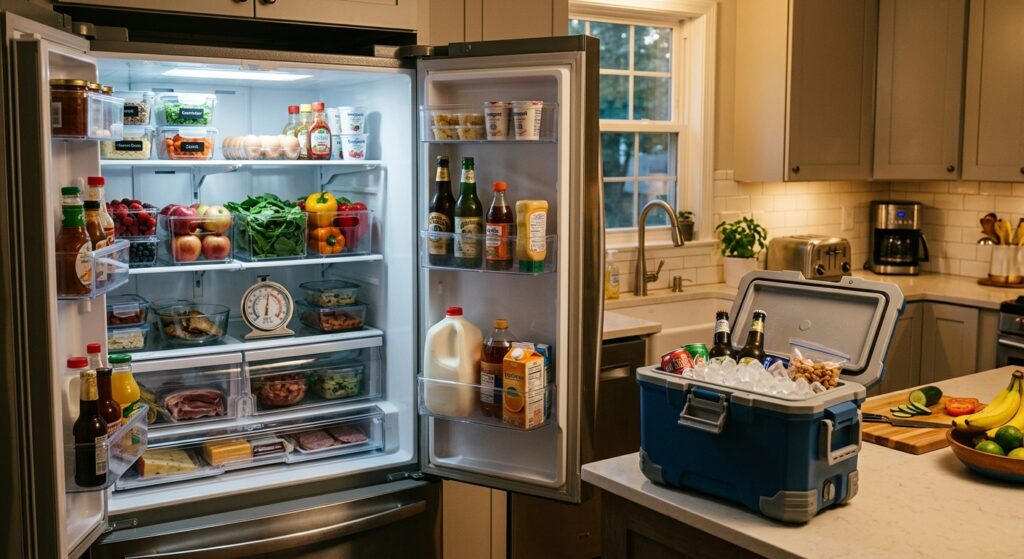
Once an outage looks likely to last longer than a few hours, shift your most important food into a cooler with ice. Prioritize items that spoil quickly, such as milk, meat, and leftovers, since these carry the highest food safety risk. In addition, block ice lasts longer than cube ice. It is worth keeping a few reusable ice blocks in the freezer specifically for this purpose. Similarly, dry ice can extend a freezer’s cold time significantly, though it requires careful handling and good ventilation.
Grouping and Organizing Food in Advance
Before an outage even happens, organize your refrigerator and freezer with this scenario in mind. Keep the items you use most often toward the front, so you spend less time with the door open searching. Meanwhile, group perishables like dairy and meat together, since this makes it easier to move them into a cooler quickly if needed. A little organization now saves real time and food loss later.
Using a Thermometer to Know for Sure
Guessing is the biggest risk factor in outage food safety. Instead, keep an appliance thermometer in both your refrigerator and freezer at all times. Food remains safe as long as the refrigerator stays at or below 40°F and the freezer stays at or below 0°F. Therefore, once power returns, check the thermometer before assuming anything inside is still good, rather than relying on how the food looks or smells.
What to Do When the Power Comes Back
When power returns, resist the urge to immediately trust everything in the fridge. First, check the thermometer reading. If the refrigerator stayed at or below 40°F throughout the outage, food inside is safe. However, if it rose above that threshold for more than 2 hours, discard perishable items like meat, dairy, and leftovers. This applies even if they still look and smell fine. As the USDA puts it, when in doubt, throw it out, since foodborne illness is not worth the risk of a saved meal.
Foods That Are Riskiest to Keep
Some foods spoil faster than others and deserve extra caution. Meat, poultry, seafood, dairy, and eggs top the list, since bacteria grow quickly in these items once temperatures rise. In addition, cooked leftovers and cut fruits or vegetables carry similar risk. Meanwhile, condiments like ketchup, mustard, and most jams are more forgiving. Their acidity or sugar content slows bacterial growth, even without refrigeration for a short time.
Longer-Term Solutions Beyond a Generator
If outages are a recurring problem in your area, a full generator is not the only option. A smaller home battery backup system can keep a refrigerator running through many outages, without the fuel logistics of a generator. Our comparison of home battery backup systems walks through the top choices. For a deeper look at longer outages, our guide on what to do when the power goes out for more than 24 hours covers the bigger picture beyond just food safety.
Building Food Safety Into Your Emergency Plan
Food safety works best as part of a broader outage plan rather than an afterthought. Our home power outage checklist walks through what to prepare before storm season, including the coolers, ice, and thermometers mentioned here. Because preparation matters more than reaction, reviewing that checklist now means less guessing and less food waste the next time the power goes out.
Preparing Your Kitchen Before Storm Season
A little prep work makes the actual outage far less stressful. Stock a few coolers, extra ice packs, and a reliable appliance thermometer well before storm season begins. In addition, keep a small notepad or phone note listing what is in your freezer, so you can prioritize what to move first if you only have limited cooler space. Because panic makes people skip steps, having these items ready in advance means you can act quickly and calmly the moment the power actually goes out.
Frequently Asked Questions
How can you keep food safe during a power outage without a generator if it lasts several days? Prioritize a full freezer, use coolers with ice for perishables, and accept that some food loss is likely beyond about 48 hours without any cooling.
Is it safe to refreeze food that partially thawed during an outage? Yes, as long as the food still contains ice crystals, or stayed at or below 40°F throughout the outage. Quality may be slightly affected, but it remains safe to eat.
Do you need a thermometer to keep food safe during a power outage? It is strongly recommended, since appearance and smell alone are not reliable indicators of whether food has reached an unsafe temperature.