
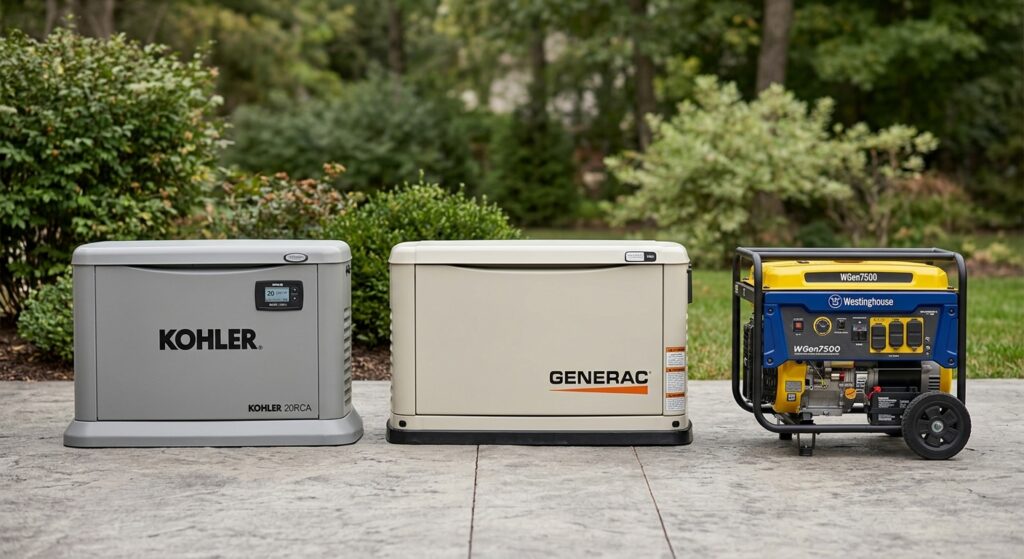
Once you’ve decided between a portable and a standby generator, the next question homeowners ask is almost always the same: which brand should I actually buy? Generac, Champion, and Briggs & Stratton dominate the U.S. residential market, but they’re not interchangeable — each one is built around a different trade-off between price, reliability, warranty support, and how easy it is to get parts and service when something breaks.
This guide compares the three brands across the factors that actually matter after the purchase, not just the spec sheet, including what happens when your unit needs a repair three years in — the point where most brand comparisons go quiet.
Quick Answer
Generac is the strongest choice for standby (whole-house) generators thanks to its dealer network and parts availability. Champion offers the best value in portable and mid-range dual-fuel units. Briggs & Stratton sits in between, with a reputation for engine durability but a smaller service network than Generac.
Generac: The Standby Market Leader
Generac invented the modern residential standby generator category and still holds roughly 75% of the U.S. home standby market. That scale is its biggest advantage: parts, certified installers, and authorized service technicians are available almost everywhere in the country, which matters enormously the day your generator won’t start during a real outage.
- Product range: Portable (GP series, 2,200–17,500 watts), standby (Guardian series, 10,000–26,000 watts)
- Typical price: Portables $400–$1,800; standby units $2,800–$6,500 (unit only)
- Warranty: 2–5 years standard depending on the model, extendable to 7–10 years
- Reputation: Excellent standby lineup, mixed reviews on portable engine longevity under heavy daily use
- Best for: Homeowners installing a standby system who want the largest dealer and service network in the country
Champion: Best Value for Portables
Champion built its reputation on undercutting Generac and Honda on price without cutting corners on the features homeowners actually use — electric start, dual-fuel capability, and quiet operation. It’s a strong choice for anyone prioritizing portable or mid-size inverter generators rather than a full standby install.
- Product range: Portable and inverter generators (2,000–12,500 watts), a smaller standby lineup (8,000–14,000 watts)
- Typical price: Portables $350–$1,400; standby units $2,000–$4,500 (unit only)
- Warranty: 3 years standard on most residential models, among the longest in the portable segment
- Reputation: Strong reputation for price-to-feature ratio; smaller dealer network than Generac for standby service
- Best for: Homeowners who want a well-equipped portable generator without paying a Generac or Honda premium
Briggs & Stratton: Engine Durability Focus
Briggs & Stratton has decades of small-engine manufacturing behind it, and that shows in how its generator engines hold up under sustained use. The brand is less aggressive on price than Champion and has a smaller standby dealer footprint than Generac, positioning it as the “engineering-first” option rather than the value or scale leader.
- Product range: Portable (1,200–17,000 watts), standby (Fortress and Symphony series, 10,000–20,000 watts)
- Typical price: Portables $400–$1,900; standby units $3,000–$7,000 (unit only)
- Warranty: 2–3 years standard, up to 5 years on select standby models
- Reputation: Well regarded for engine build quality; service network noticeably thinner outside larger metro areas
- Best for: Buyers prioritizing engine longevity who have confirmed local service availability before buying
Side-by-Side Comparison
| Factor | Generac | Champion | Briggs & Stratton |
|---|---|---|---|
| Best category | Standby generators | Portable & inverter generators | Engine durability |
| Portable price range | $400 – $1,800 | $350 – $1,400 | $400 – $1,900 |
| Standby price range | $2,800 – $6,500 | $2,000 – $4,500 | $3,000 – $7,000 |
| Standard warranty | 2–5 years | 3 years | 2–3 years |
| Dealer/service network | Largest in the U.S. | Growing, smaller than Generac | Smallest of the three |
| Parts availability | Excellent | Good | Fair, regional variation |
| Noise (portable, avg.) | 64–68 dB | 61–64 dB | 65–70 dB |
What Actually Happens When a Generator Breaks
This is the part most comparisons skip. Reliability isn’t just about how often a unit fails — it’s about how fast you can get it running again.
With Generac, the large certified-dealer network means most residential areas have at least one authorized service center within a reasonable drive, and common parts (batteries, filters, transfer switch components) are typically in stock or a short order away. This is the single biggest reason Generac dominates the standby segment despite not being the cheapest option.
With Champion, portable-unit repairs are often simpler and can be handled by a general small-engine shop, since the engines use widely available components. Standby-specific service is improving but is still concentrated in larger metro areas — worth checking before buying a Champion standby unit specifically.
With Briggs & Stratton, engine parts are broadly available because the company also supplies engines to lawn and garden equipment, which helps with portable units. However, standby-specific service technicians are less common outside major cities, and rural buyers report longer wait times for scheduled maintenance visits.
Real-World Scenario Comparison
A homeowner in a hurricane-prone coastal county installing a whole-house standby system. Generac is the safer default here — if the unit needs emergency service during peak storm season, the odds of finding an available certified technician nearby are highest with Generac’s network.
A homeowner who wants a capable portable generator for occasional outages and weekend camping trips. Champion typically wins on price-to-feature ratio, especially in the inverter category where quiet operation and electric start matter for both use cases.
A rural homeowner with a barn, workshop, and home to power, prioritizing an engine that will still run reliably at year 10. Briggs & Stratton’s engine-first reputation makes it a reasonable pick, provided the buyer confirms a local dealer exists — this is the brand where skipping that check causes the most regret.
4 Mistakes Homeowners Make When Comparing These Brands
- Choosing a brand based on price alone without checking local dealer coverage. A cheaper unit with no nearby service center can cost more in downtime than a slightly pricier one with same-day support.
- Assuming all three brands’ warranties cover the same thing. Standard warranties often exclude labor after the first year, or require proof of professional installation and annual maintenance — read the fine print before assuming a 5-year warranty means 5 years of free repairs.
- Comparing portable models to standby models across brands. Generac’s portable lineup and Champion’s standby lineup are each the weaker side of their respective catalogs; compare like-for-like categories, not just brand reputation as a whole.
- Ignoring noise level for close-neighbor properties. A 6–8 dB difference sounds small on paper but is very noticeable in practice, especially in suburban lots with tight setbacks — worth testing in person or watching video reviews before buying.
Frequently Asked Questions
Which brand has the best warranty?
Generac typically offers the longest standard and extendable warranty terms, particularly on standby units, though Champion’s 3-year standard portable warranty is competitive for the price point.
Is Champion as reliable as Generac?
For portable and inverter generators, Champion’s reliability is considered comparable to Generac’s. For standby systems, Generac’s larger installed base and longer track record give it an edge in long-term reliability data.
Does Briggs & Stratton make good standby generators?
Yes, the engines are well regarded, but buyers should confirm local service network coverage before choosing Briggs & Stratton for a standby installation, since availability varies significantly by region.
Which brand is easiest to get parts for?
Generac, due to its dominant market share and dealer count, followed by Briggs & Stratton for portable-unit engine parts specifically.
Bottom Line
There’s no single “best” brand — the right choice depends on whether you’re buying portable or standby, how much local dealer support matters in your area, and how much weight you put on price versus long-term service network. Generac leads for standby installations, Champion leads for portable value, and Briggs & Stratton is a solid engine-first pick once local service availability is confirmed. Check our guides on portable vs standby generators and on choosing the right generator size before finalizing your decision.