
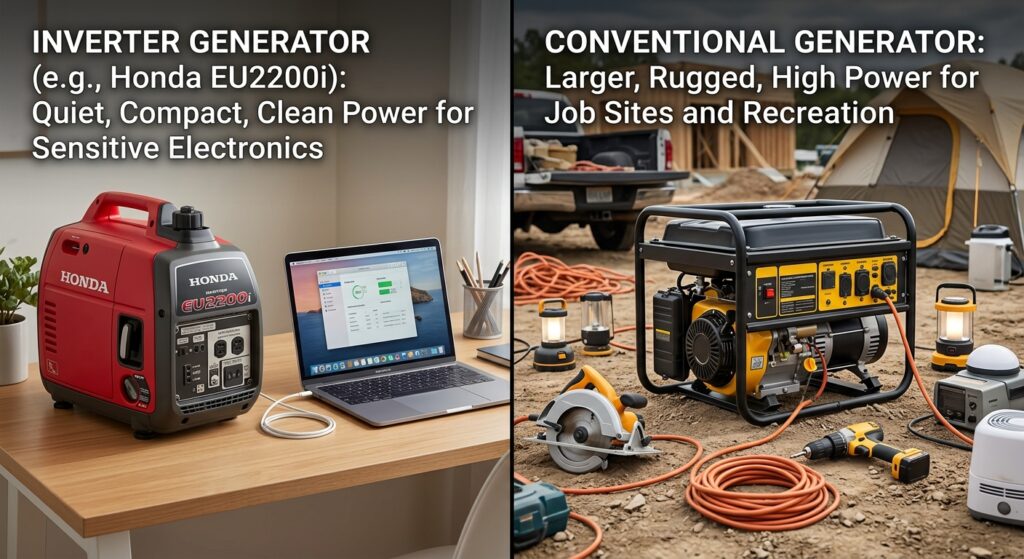
Choosing between an inverter vs conventional generator is the second big decision every generator buyer faces, right after deciding between portable and standby. Both technologies burn fuel to make electricity, but the way each one delivers that electricity is fundamentally different — and it affects everything from the safety of your electronics to how much you’ll actually spend on gas over a season.
This guide breaks down the real inverter vs conventional generator trade-offs: power quality, noise, fuel cost per hour, and which situations call for one over the other, including two details most buying guides skip entirely — how to test power quality yourself, and what fuel efficiency actually costs you in dollars.
Quick Answer
In the inverter vs conventional generator debate, inverter units win on clean power, noise, and fuel efficiency, making them the safer choice for laptops, phones, and sensitive electronics. Conventional generators win on raw power per dollar, making them the better pick for high-wattage tools and whole-home backup where clean power isn’t a priority.
What Is a Conventional Generator?
A conventional generator uses a mechanical alternator spinning at a fixed speed (typically 3,600 RPM) to produce AC power directly. This design is simple, durable, and inexpensive to manufacture, which is why conventional generators dominate the higher-wattage and standby segments of the market.
- Power quality: Raw AC output, with voltage fluctuations of around 8–10% (Total Harmonic Distortion)
- Typical output: 3,000–17,000+ watts
- Typical price: $400–$1,800 (portable), scales up for standby units
- Noise: 70–75 dB at 23 feet, runs at a constant engine speed regardless of load
What Is an Inverter Generator?
An inverter generator produces raw AC power, converts it to DC, then inverts it back into clean, stable AC through electronic circuitry — the same basic principle used in solar systems and UPS battery backups. This extra step is what makes an inverter generator safe for sensitive electronics.
- Power quality: Clean AC output, voltage fluctuations under 3% THD, safe for laptops, phones, and medical equipment
- Typical output: 1,000–7,000 watts (rarely goes higher due to cost)
- Typical price: $400–$2,500, generally pricier per watt than conventional units
- Noise: 52–62 dB at 23 feet; many models throttle engine speed down under light load
Inverter vs Conventional Generator: Full Comparison Table
| Factor | Inverter Generator | Conventional Generator |
|---|---|---|
| Power quality | Clean, stable (under 3% THD) | Raw, fluctuating (8–10% THD) |
| Safe for electronics | Yes, by design | Risky without added protection |
| Noise | 52–62 dB, often variable | 70–75 dB, constant |
| Fuel efficiency | Higher (variable speed) | Lower (constant speed) |
| Max wattage available | Up to ~7,000W | Up to 17,000W+ |
| Price per watt | Higher | Lower |
| Weight | Lighter, more portable | Heavier, bulkier |
| Parallel capability | Many models can link two units | Not typically available |
What an Inverter vs Conventional Generator Actually Costs You Per Hour
Specs sheets rarely translate fuel efficiency into real dollars, so here’s the comparison in practical terms. Running a mid-size unit (around 3,500 running watts) at roughly half load for one hour:
- Conventional generator: burns about 0.3–0.4 gallons/hour regardless of actual load, since the engine runs at a fixed speed. At $3.50/gallon, that’s roughly $1.05–$1.40 per hour, even when only powering a fridge and a few lights.
- Inverter generator: the engine throttles down under light load, burning closer to 0.15–0.2 gallons/hour in the same scenario — roughly $0.53–$0.70 per hour, about half the cost for the identical task.
Over a 3-day outage running 10 hours a day, that gap adds up to $15–$21 in fuel savings — modest on its own, but it partly offsets an inverter generator’s higher purchase price over a few seasons of use.
A Simple Way to Test Power Quality Yourself
You don’t need lab equipment to get a rough sense of how “clean” your generator’s output is. A cheap plug-in power quality meter (around $15–$25) that displays voltage and frequency will show you how stable a conventional generator’s output really is under a changing load: turn on a large appliance and watch the voltage dip and recover. On a well-tuned inverter generator, that same reading barely moves. It’s a useful five-minute test before trusting either unit with a laptop charger or medical device, and it’s a step almost no other buying guide mentions.
Real-World Scenario Comparison
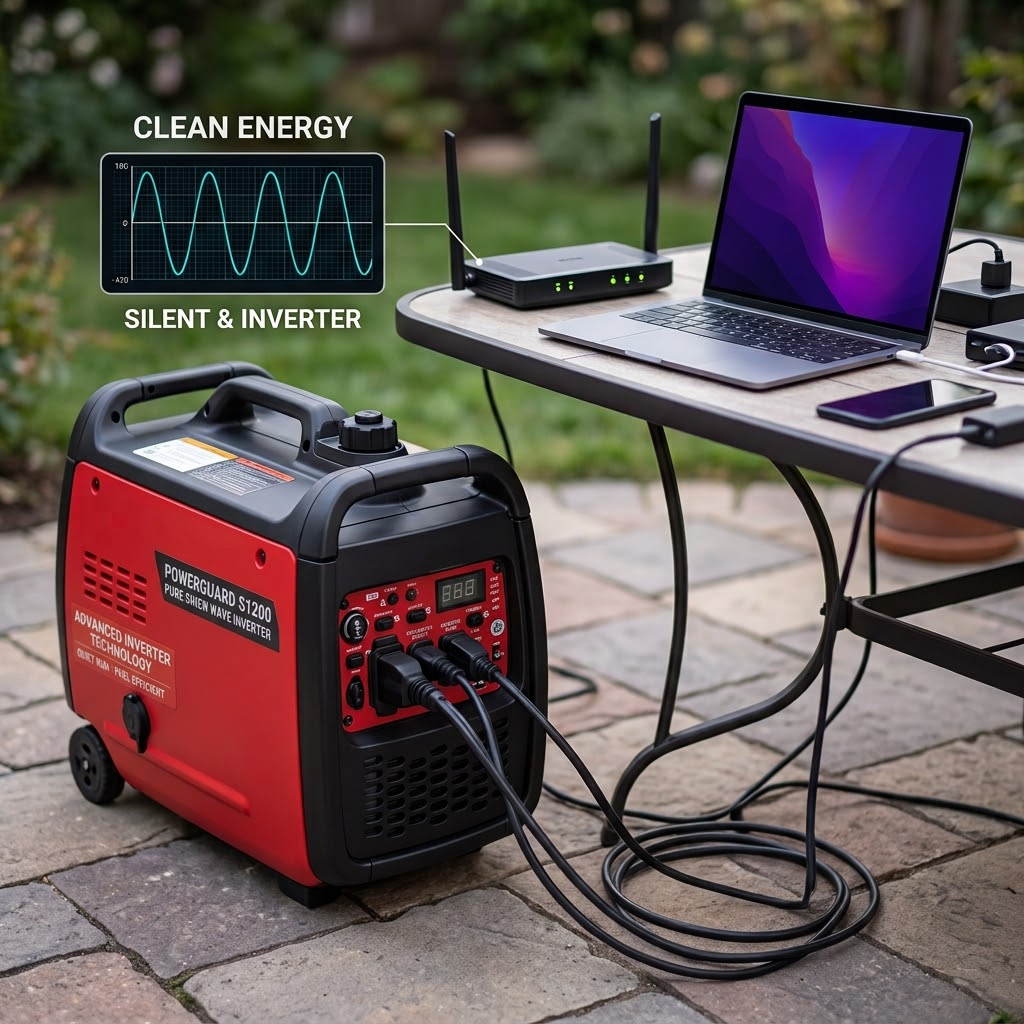
A remote worker who needs a laptop, monitor, and Wi-Fi router running during outages. An inverter generator is the clear choice — clean power protects the equipment, and lower noise makes it tolerable to run for a full workday.
A homeowner running a well pump, refrigerator, and a few lights, with no sensitive electronics plugged in directly. A conventional generator delivers more wattage per dollar, and the power-quality gap matters far less for pumps and older-style appliances.
A contractor running power tools on a job site. Conventional generators are usually preferred, since simple motors don’t need clean power, and higher wattage at a lower price per watt matters more than portability.
Can You Get the Best of Both?
Yes. Several inverter models support parallel operation, letting you connect two smaller units to double available wattage while keeping clean power. If budget requires a conventional generator but electronics protection matters, adding a dedicated surge protector between the generator and sensitive devices meaningfully reduces the risk from unstable power. For more on sizing either option correctly, see our guide on how to choose the right generator size and our full breakdown of portable vs standby generators.
4 Mistakes Homeowners Make When Choosing Between the Two
- Plugging laptops or smart TVs directly into a conventional generator without protection. The most common electronics-damage complaint in owner forums, and avoidable with an inverter unit or a simple surge protector.
- Assuming inverter generators can cover whole-home backup. Most top out around 7,000 watts — not enough for central AC plus multiple large appliances. For true whole-house coverage, a standby generator is usually necessary.
- Overlooking parallel capability when comparing prices. Two smaller, cheaper parallel-capable inverter units sometimes cost less combined than one large single unit, with more flexibility.
- Ignoring altitude and temperature derating. Both types lose output at high altitude or extreme heat; check the manufacturer’s derating chart if you live above 5,000 feet. The U.S. Department of Energy’s generator efficiency guidance covers this in more technical detail.
Frequently Asked Questions
Is an inverter generator always better than a conventional generator?
Not always — it depends on the load. For electronics, medical equipment, and noise-sensitive situations, inverter wins. For maximum wattage per dollar on tools or basic appliances, conventional is usually more cost-effective.
Can a conventional generator damage a laptop?
It’s uncommon but possible over repeated use, due to voltage fluctuations affecting sensitive charging circuitry. A surge protector or an inverter generator largely eliminates this risk.
Which is safer for medical equipment?
Inverter generators, by a wide margin — manufacturers of CPAP machines and oxygen concentrators frequently specify inverter-only power in their compatibility guidelines. For general electrical safety around generators, OSHA’s portable generator safety guidance is a useful reference before first use.
Bottom Line
The inverter vs conventional generator choice comes down to what you’re powering, not just how much power you need. Choose inverter for electronics, medical equipment, and noise-sensitive situations; choose conventional for maximum wattage per dollar on tools and appliances that don’t need clean power.