
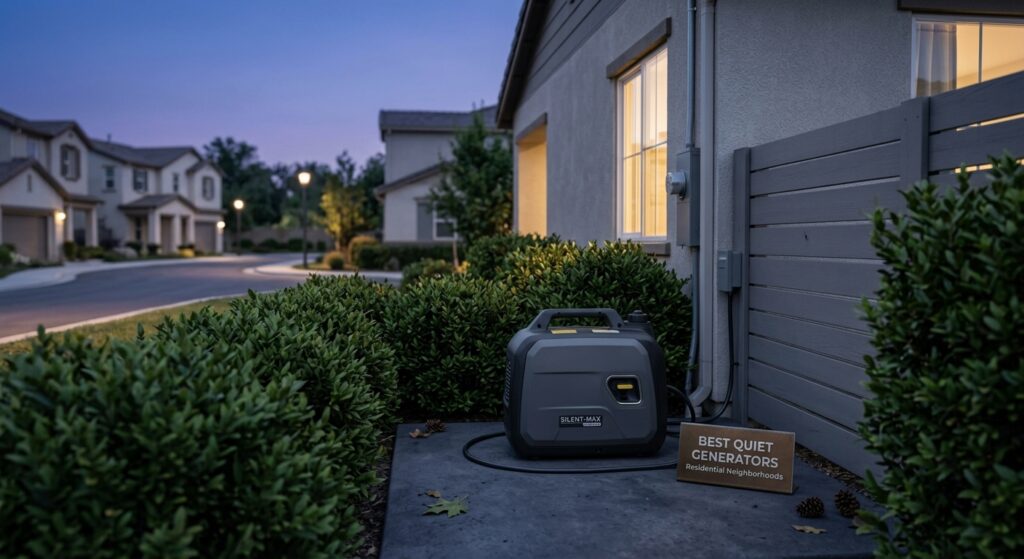
The best quiet generators for residential neighborhoods are not simply the ones with the lowest number on the box. They are the ones measured the way you will actually hear them. Most manufacturers quote decibels at 7 meters, or about 23 feet, and many list two numbers: one at full load and one at one-quarter load. This guide shows how to read those numbers, why inverter technology matters, and which quiet models suit a suburban lot.
What dB at 7 Meters Really Means
Decibels are measured on a logarithmic scale. A jump of 10 dB sounds roughly twice as loud to most people. Therefore, a 58 dB generator and a 68 dB generator make very different neighbors.
Distance changes the number too. In open space, noise drops by about 6 dB each time you double the distance. The table below shows what that means for a generator rated at 57 dB(A) at 7 meters.
| Distance from generator | Estimated noise |
|---|---|
| 7 meters (23 feet) | 57 dB(A) |
| 14 meters (46 feet) | About 51 dB(A) |
| 28 meters (92 feet) | About 45 dB(A) |
These are rough estimates. Fences, houses, and trees all change the result. Still, the pattern is clear: moving the generator farther away helps more than most buyers expect.
Also check which load the rating uses. The best quiet generators publish both numbers. Honda lists its EU2200i at 57 dB(A) at rated load and 48 dB(A) at one-quarter load. That 9 dB gap is large. At night, when you run only a fridge and a few lights, the generator stays near the quieter number.
Why Inverter Technology Makes the Difference
An inverter generator adjusts engine speed to match the load. Because the engine slows down under light loads, noise drops. In addition, most inverter models use sound-dampening housings and larger mufflers. Honda calls its version Eco-Throttle, while Yamaha calls its system Smart Throttle.
Conventional open-frame models run at a fixed speed. As a result, they stay loud even when the load is small. For example, the Champion 4375/3500 open-frame dual fuel generator lists 68 dBA from 23 feet. That is about 10 dB louder than a Honda inverter at rated load. Our comparison of inverter vs conventional generators covers the other differences.
| Type | Example | Noise at 7 meters (23 feet) |
|---|---|---|
| Inverter | Honda EU2200i | 48 to 57 dB(A) |
| Inverter | Honda EU3200i | 54 to 58 dB(A) |
| Open-frame conventional | Champion 4375/3500 dual fuel | 68 dBA |
Best Quiet Generators for Residential Neighborhoods
Two Honda inverter models stand out for suburban use. Prices change often, so check current listings before you buy.
Honda EU2200i: Quietest All-Rounder
The Honda EU2200i produces 2,200 starting watts and 1,800 running watts. It runs at 48 to 57 dB(A) and weighs 47.4 pounds. The 0.95-gallon tank lasts 3.2 hours at rated load and up to 8.1 hours at one-quarter load. In addition, its CO-Minder sensor shuts the unit down if carbon monoxide builds up nearby.
That output covers a refrigerator, lights, a router, and phone chargers. However, it will not run central air. It also has a recoil start only, and Honda lists it at $1,199.
Honda EU3200i: Quiet With More Power
The Honda EU3200i steps up to 3,200 starting watts and 2,600 running watts. It runs at 54 to 58 dB(A), which is only slightly louder than the EU2200i. Its 1.2-gallon tank lasts 3.3 hours at rated load and up to 8.6 hours at one-quarter load. It weighs 59.1 pounds.
Moreover, it adds a 30-amp locking receptacle. That makes it a better fit for a furnace blower or a larger fridge during winter outages. The trade-off is weight and cost. If you only need small loads, the EU2200i is quieter and easier to carry.
| Model | Starting / running watts | Noise (rated / one-quarter load) | Dry weight | Runtime at one-quarter load |
|---|---|---|---|---|
| Honda EU2200i | 2,200 / 1,800 W | 57 / 48 dB(A) | 47.4 lb | 8.1 hours |
| Honda EU3200i | 3,200 / 2,600 W | 58 / 54 dB(A) | 59.1 lb | 8.6 hours |
Need something even quieter and smaller? The Honda EU1000i runs at 42 to 50 dB(A). See our camping generator guide for the details.
Placement: The Cheapest Noise Reduction
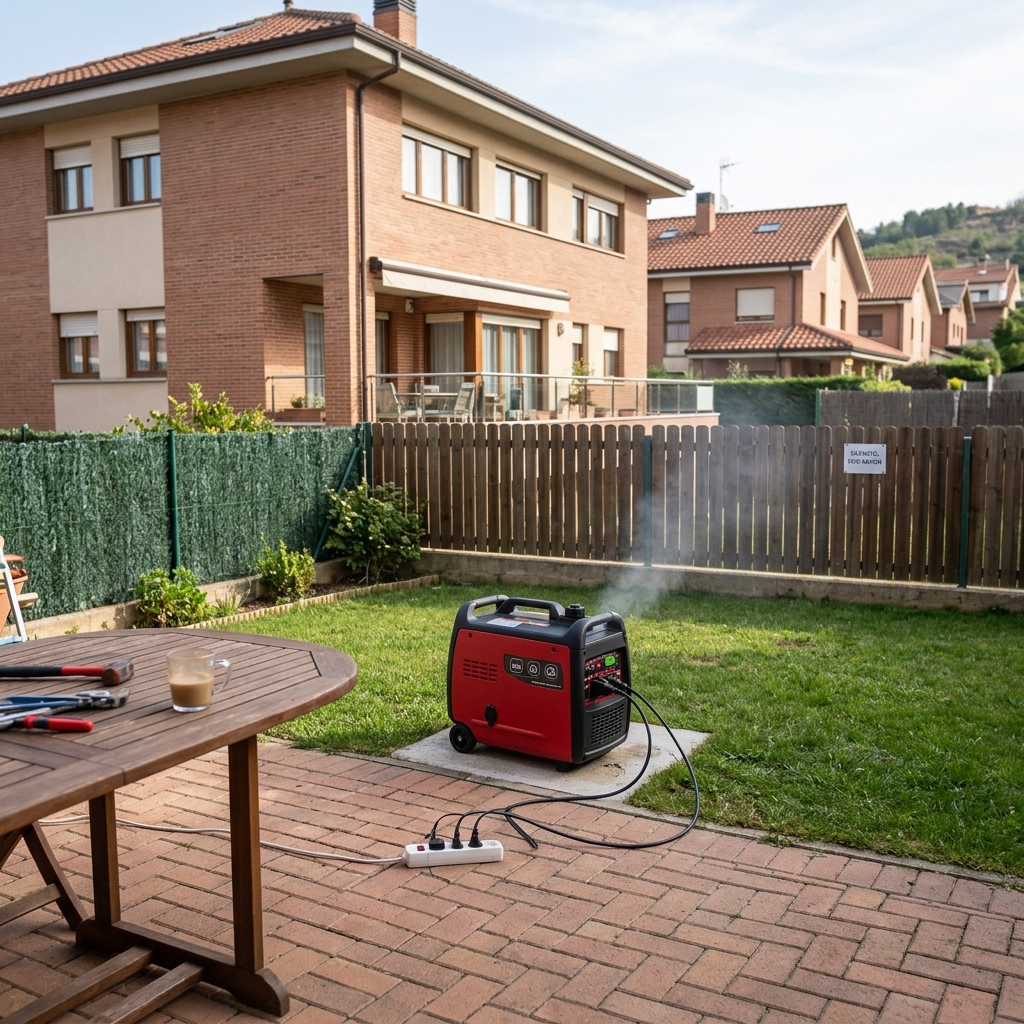
Even the best quiet generators can annoy neighbors if you place them badly. Follow these steps:
- Place the generator as far from neighbors as safety rules allow. Each doubling of distance cuts about 6 dB.
- Put a solid fence or wall between the generator and the nearest bedroom window.
- Point the exhaust and the engine side away from shared property lines.
- Never enclose a running generator in a box or shed. This traps carbon monoxide and heat.
Safe placement near your own house matters just as much. Read our guide to running a portable generator safely before you choose a spot.
Check Local Noise Rules First
Many cities set residential noise limits, and they are often lower at night. Because rules vary by city and county, read your municipal code before you buy. The EPA noise pollution page gives background on federal noise law, although enforcement happens locally. If you want a permanent setup, see how loud standby units are in our guide to whole-house generator noise.
Quick Answers
What dB level is quiet enough for a neighborhood? Aim for a rating under 60 dB at 7 meters, then add distance and a solid barrier. Check the rating at both rated load and one-quarter load.
What makes the best quiet generators quiet? Inverter technology, variable engine speed, and a sound-dampening housing. Together, they lower noise when the load is light.
Is a bigger generator always louder? Not always. The Honda EU3200i is only 1 dB(A) louder than the EU2200i at rated load, even though it makes 1,000 more watts.
Final Thoughts
The best quiet generators are inverter models with honest, load-specific dB ratings. Compare the figures at 7 meters, not the marketing labels. Then add distance and a solid barrier to cut what your neighbors hear. With the right choice and placement, backup power can stay in the background.