
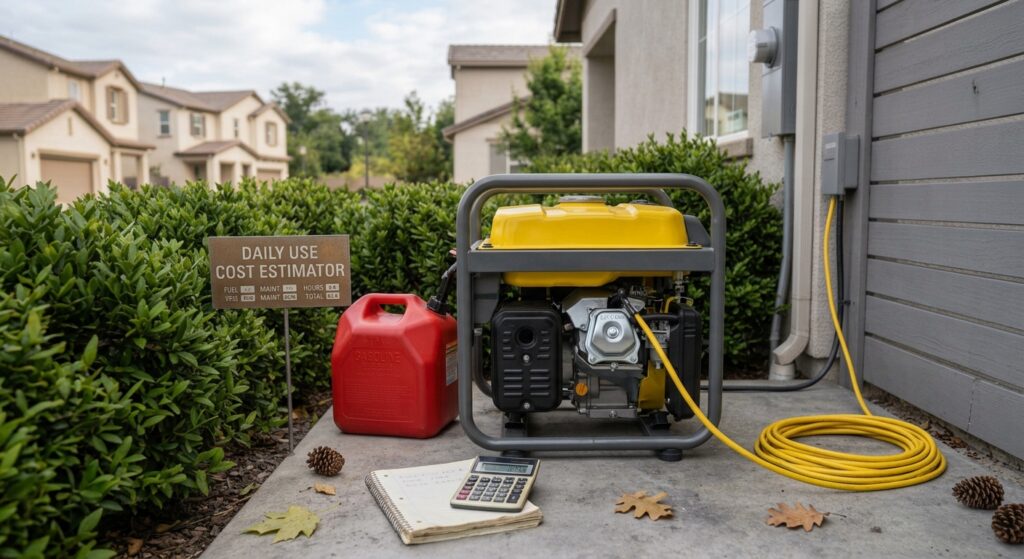
Knowing the portable generator cost to run per day matters more than most buyers expect, since fuel expense adds up fast during a multi-day outage. A generator’s purchase price is only the beginning of the real cost, and load, wattage, and fuel type each change the daily number significantly.
This guide breaks down exactly what a portable generator costs to run per day across common wattage sizes and fuel types, plus the load factors that can quietly double your fuel bill without you realizing it.
Quick Answer
A mid-size portable generator (around 5,000 running watts) at moderate load typically costs $15–$30 per day in gasoline, $18–$35 in propane, or $12–$24 in diesel, assuming roughly 10–12 hours of daily runtime during a typical outage.
Daily Cost by Generator Size
Fuel consumption scales with both the generator’s wattage rating and how much of that capacity you’re actually using. Here’s a realistic breakdown at moderate load (around 50% of rated capacity), running 10 hours a day:
| Generator size | Gasoline cost/day | Propane cost/day | Diesel cost/day |
|---|---|---|---|
| 2,000–3,000W (small inverter) | $6–$11 | $8–$13 | N/A (rarely available at this size) |
| 4,000–5,500W (mid-size) | $15–$25 | $18–$30 | $12–$20 |
| 7,000–8,500W (large) | $25–$40 | $30–$48 | $18–$32 |
| 10,000W+ (whole-home portable) | $35–$55 | $42–$65 | $25–$42 |
These figures assume a 50% load; running closer to full capacity increases fuel burn disproportionately, since generators become less fuel-efficient near their maximum rated output.
Why Load Matters More Than Most People Expect
A generator running at 25% load doesn’t burn a quarter of the fuel it would at full load — it burns considerably more per kWh delivered, because engines are least efficient at very light loads. Conversely, running near 100% capacity for extended periods increases wear and can also slightly reduce efficiency due to heat buildup.
The sweet spot for both cost and equipment longevity sits around 50–75% of rated load. Practically, this means it’s often more economical to run a slightly smaller generator closer to its capacity than an oversized one at a fraction of its rating, assuming the smaller unit still covers your essential appliances.
What Actually Drives Up Daily Cost
Central air conditioning is the single biggest cost driver when included in a generator’s load, often doubling or tripling daily fuel consumption compared to running just a refrigerator and lights.
Electric water heaters draw significant continuous wattage and, unlike a refrigerator that cycles on and off, can run for extended stretches, adding steadily to fuel use throughout the day.
Well pumps, while not typically running continuously, draw high starting wattage each time they cycle on, which increases average fuel consumption more than their modest running wattage alone would suggest.
By contrast, LED lighting, Wi-Fi routers, phone chargers, and a standard refrigerator add relatively little to daily fuel cost, since their combined wattage rarely exceeds a few hundred watts.
A Simple Way to Estimate Your Own Daily Cost
Add up the running watts of what you actually plan to power, divide by your generator’s rated wattage to estimate the load percentage, then check the closest matching row in the table above. For a more precise number, most manufacturers publish a runtime-at-50%-load figure in gallons per hour, which can be multiplied by your local fuel price and expected daily runtime hours for a tailored estimate specific to your unit.
Real-World Cost Comparison Over a 3-Day Outage
Using a mid-size 5,000W gasoline generator at moderate load for 10 hours a day, a 3-day outage costs roughly $45–$75 in fuel alone. Extending that same scenario to a full week pushes the total to around $105–$175, a number worth budgeting for in advance rather than discovering mid-outage when local fuel prices sometimes spike due to increased regional demand.
For more on choosing fuel type based on both cost and availability during emergencies, see our guide on gas vs propane vs diesel generators. If you’re still deciding on generator size before estimating cost, our guide on how to choose the right generator size is the right starting point.
3 Mistakes That Inflate Daily Generator Cost
- Running unnecessary appliances just because the generator can handle them. Skipping central AC or an electric water heater during a short outage can cut daily fuel cost significantly without meaningfully reducing comfort.
- Buying an oversized generator and running it at very light load. A generator running well under its efficient operating range burns more fuel per kWh delivered than a properly sized unit at moderate load.
- Not checking fuel prices during regional emergencies. Prices can spike temporarily during widespread outages, and budgeting only for normal, non-emergency fuel prices can lead to underestimating real costs.
Frequently Asked Questions
How much does it cost to run a generator for a week?
For a mid-size 5,000W generator on gasoline at moderate load, expect roughly $105–$175 for a full week of 10-hour daily runtime.
Does running a generator at full load cost more per hour?
Yes, generators become less fuel-efficient per kWh delivered as they approach full rated capacity, so running closer to 100% load increases cost more than proportionally.
What uses the most fuel when running a generator?
Central air conditioning and electric water heaters are the biggest daily cost drivers, often doubling or tripling fuel consumption compared to running only essential appliances.
Is propane more expensive to run than gasoline day to day?
Generally yes, propane typically costs somewhat more per day than gasoline for the same load, due to its lower energy density per gallon, though it offsets this with indefinite storage life.
Bottom Line
The real portable generator cost to run per day depends heavily on load and fuel type, typically landing between $15 and $35 for a mid-size unit at moderate load. Planning your appliance list in advance, choosing the right generator size, and understanding your fuel type’s daily cost helps avoid unpleasant surprises during a multi-day outage.