
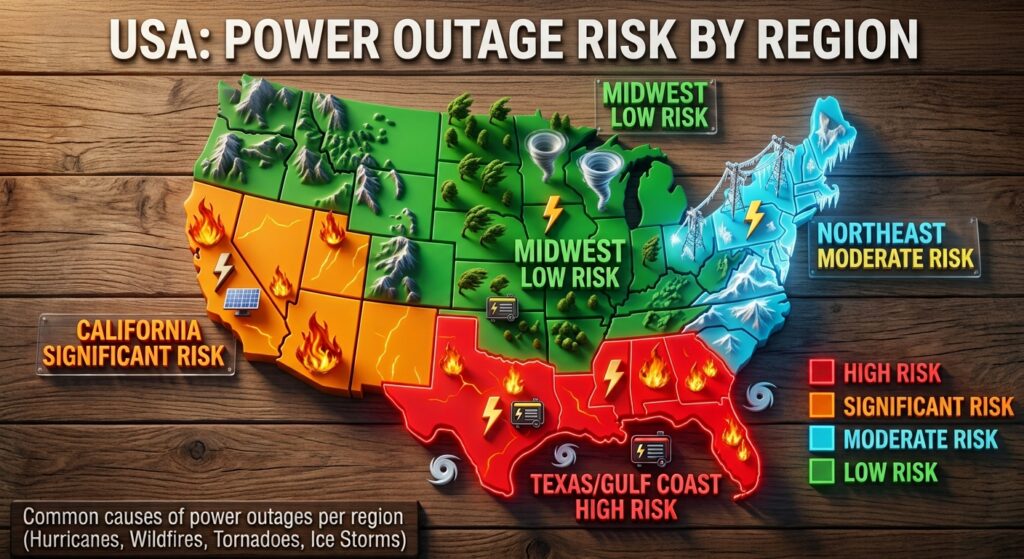
Is a home generator worth the investment where you live? The honest answer depends heavily on region, since outage frequency varies enormously across the country. A generator that pays for itself within a year in one state might sit unused for years in another. This guide breaks down where the investment makes the most sense, and why.
What Makes a Home Generator Worth the Investment
Three factors matter most when weighing this decision. First, how often does your area lose power. Second, how long do outages typically last once they happen. Third, how extreme is the local climate, since heat and cold both raise the stakes of going without power. According to the U.S. Energy Information Administration, weather-related events now account for the majority of extended outages nationwide. This makes regional climate risk central to the decision.
The Gulf Coast and Hurricane Belt
Florida, Louisiana, and coastal Texas face the clearest case for backup power. Hurricane season brings not just occasional storms, but a near-annual risk of multi-day outages across entire regions. In addition, downed power lines from high winds can take utility crews days or even weeks to fully repair after a major storm. Because of this, homeowners in these states often see a generator pay for itself within one or two significant storm seasons. Avoided food spoilage and comfort during extended summer heat both add up quickly.
Wildfire-Prone California
California presents a different but equally strong case. Utilities there now conduct planned Public Safety Power Shutoffs during high wildfire risk periods, cutting power intentionally to reduce fire danger. As a result, homeowners in fire-prone areas can lose power multiple times per fire season, even without an actual storm or grid failure. Therefore, a generator or battery system here functions less as emergency backup. It becomes a routine necessity during certain months of the year.
The Midwest and Ice Storm Belt
States like Michigan, Ohio, and Missouri deal with a different threat. Ice storms and severe summer thunderstorms both bring down power lines regularly. Ice accumulation on trees and wires can cause outages lasting several days, particularly in wooded suburban and rural areas. Meanwhile, aging grid infrastructure in parts of this region means restoration can take longer than in states with newer utility investment. Because winter outages here also carry serious cold-exposure risk, a generator is often considered a safety investment as much as a convenience one.
The Northeast and Nor’easter Country
Massachusetts, Maine, and upstate New York regularly face Nor’easters that combine heavy snow with damaging winds. Similarly to the ice storm belt, tree-heavy suburban areas see the longest outages, since falling branches account for a large share of line damage. In addition, older housing stock in this region often relies more heavily on electric heat. This raises the urgency of backup power during winter storms specifically.
Texas: A Special Case Worth Noting
Texas deserves its own mention beyond the general Gulf Coast category. In addition to hurricane risk along the coast, the state’s independent power grid has faced well-documented strain during extreme winter weather. As a result, some Texas homeowners now consider backup power a safeguard against both summer storms and rare but severe winter grid events. Because the state’s grid operates separately from neighboring systems, it cannot always draw emergency power from other regions during a crisis, which is a factor worth understanding if you live there.
Where a Generator Matters Less
Not every region faces the same risk. Areas with historically stable grids and mild weather, such as parts of the interior Pacific Northwest away from wildfire zones, see fewer prolonged outages. However, this does not mean a generator has no value there. Instead, it simply means the payback period is longer, and the decision leans more on personal risk tolerance than on regional necessity. For homeowners in lower-risk areas, a smaller battery-based option may make more financial sense than a full standby generator.
Factors Beyond Your State
Location within a state matters as much as the state itself. Rural properties served by long above-ground power lines tend to lose power more often than dense urban areas with buried infrastructure. In addition, homes with a household member who depends on medical equipment should weight the decision toward backup power. Here, the stakes of an outage are simply higher, regardless of regional averages. Therefore, treat regional data as a starting point, not the final word, when deciding whether a generator is worth it for your specific home.
Weighing the Investment Against the Cost
Once you have a sense of your regional risk, the next question is straightforward. Does the cost actually make sense for your situation? Our guide on home battery backup cost breaks down real pricing across brands and capacities. Our comparison of home battery backup systems covers how batteries stack up against traditional generators. For homeowners just starting to plan, our home power outage checklist is a useful next step regardless of which backup option you eventually choose.
How to Estimate Your Own Payback Period
Start by estimating how many outage days your household experiences per year. Base this on recent memory or local news coverage of major storms. Next, multiply that by a rough daily cost of lost food, missed remote work, or hotel stays if extreme temperatures force you to leave home. Compare that annual cost against the price of a generator or battery system. In high-risk regions, this math often favors backup power within just a few years. In lower-risk regions, it may take considerably longer, which is worth factoring into the decision honestly.
Frequently Asked Questions
Is a home generator worth the investment in every state? Not equally. High-risk regions like the Gulf Coast, wildfire-prone California, and the ice storm belt see the clearest financial and safety case. Milder, low-outage regions see a longer payback period.
Does homeowner’s insurance affect whether a generator is worth it? Some insurers offer minor discounts for homes with backup power. However, this varies significantly by provider and state, so check with your specific insurer.
What if I live in a low-risk area but still want backup power? A smaller, less expensive battery-based system is often a reasonable middle ground, offering essential backup without the larger investment of a full standby generator.