
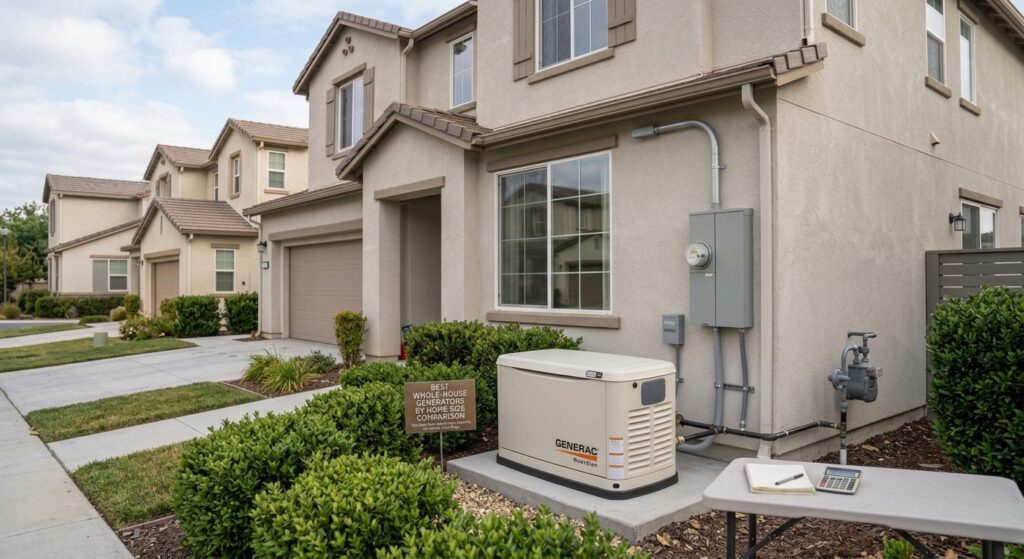
Finding the best whole-house generators by home size starts with matching kW capacity to your actual square footage and appliance load, not just picking the biggest unit you can afford. An oversized generator wastes money on both the unit and installation, while an undersized one leaves you rationing power during exactly the outage you bought it for.
This guide breaks down recommended generator sizes by home size, what changes the calculation, and which capacity ranges make sense for different household setups.
Quick Answer
Small homes (under 1,500 sq ft) typically need 10,000–12,000W, medium homes (1,500–2,500 sq ft) need 14,000–17,000W, large homes (2,500–4,000 sq ft) need 18,000–22,000W, and very large homes often require 22,000W+ or two paralleled units.
Why Square Footage Alone Doesn’t Tell the Whole Story
Square footage is a useful starting point, but the real driver of generator size is your home’s actual electrical load, particularly high-draw appliances like central air conditioning, electric water heaters, and well pumps. Two homes of identical size can have meaningfully different generator needs depending on whether they have gas or electric heating, one or two AC units, and how many major appliances need to run simultaneously.
As a result, the sizes below are strong starting points, but a licensed installer’s load calculation, which accounts for your specific appliance list, remains the most reliable way to confirm final sizing before purchase.
Best Generator Sizes by Home Size
Small homes (under 1,500 sq ft): 10,000–12,000W. This range comfortably covers a refrigerator, lighting circuits, a well pump if applicable, a single central AC unit (or window units), and general outlets. It’s the most common size for starter homes, condos with limited electrical load, and smaller ranch-style properties.
Medium homes (1,500–2,500 sq ft): 14,000–17,000W. This is the most popular size range overall, since it covers a full central AC system, an electric water heater, a well pump, and typical household circuits simultaneously without requiring careful load rotation.
Large homes (2,500–4,000 sq ft): 18,000–22,000W. Homes in this range often have two-zone HVAC systems, larger electric water heaters, and more simultaneous appliance demand, making this capacity necessary to avoid overloading the unit during peak usage.
Very large homes (4,000+ sq ft): 22,000W+ or paralleled units. Some homeowners in this range choose two smaller generators wired to run in parallel rather than one very large unit, which offers redundancy (one unit can still provide partial power if the other needs service) and can be more efficient if only part of the home’s full load is needed most of the time.
Comparison Table by Home Size
| Home size | Recommended capacity | Typical unit cost | Covers |
|---|---|---|---|
| Under 1,500 sq ft | 10,000–12,000W | $2,500–$3,500 | Essentials + 1 AC zone |
| 1,500–2,500 sq ft | 14,000–17,000W | $3,500–$5,000 | Full home, single AC system |
| 2,500–4,000 sq ft | 18,000–22,000W | $5,000–$6,500 | Full home, dual-zone HVAC |
| 4,000+ sq ft | 22,000W+ or paralleled | $6,500+ | Full home, high simultaneous load |
What Changes the Recommended Size Up or Down
Electric vs gas heating and water heating. Homes with electric furnaces or electric water heaters need meaningfully more capacity than otherwise identical homes using gas for those systems, since electric heating elements draw substantial continuous wattage.
Well pump presence. A well pump’s high starting wattage, even though it doesn’t run continuously, can push a borderline-sized generator to the next capacity tier up, particularly in homes without municipal water service.
Number and size of AC units. Multiple AC zones or a single large central unit both increase starting and running wattage requirements significantly compared to a smaller single-zone home.
Pools, hot tubs, or workshop equipment. Homes with a pool pump, spa, or a workshop with power tools should add that load explicitly to the calculation rather than relying on general home-size estimates alone.
Should You Size Up “Just in Case”?
A modest buffer, typically sizing one tier above your calculated minimum, is reasonable and gives room for future appliance additions like an EV charger or a home addition. However, significantly oversizing beyond that buffer increases both unit and installation cost without meaningful benefit, since the generator will spend most outages running well under its capacity, which isn’t harmful but also isn’t cost-effective. For a full walkthrough of calculating your specific load rather than relying on home-size averages alone, see our guide on how to choose the right generator size.
3 Mistakes Homeowners Make When Sizing by Home Size
- Using square footage alone without accounting for electric heating or a well pump. These factors can push actual needs a full capacity tier above what square footage alone would suggest.
- Sizing for current needs only, without considering planned additions like an EV charger. A modest buffer avoids needing to upgrade the entire system within a few years of installation.
- Assuming bigger is always safer without weighing the added installation cost. A significantly oversized unit increases gas line and electrical work costs without proportional benefit for most households.
Frequently Asked Questions
What size generator do I need for a 2,000 sq ft house?
Most 2,000 sq ft homes fall in the medium range, typically needing 14,000–17,000W, though electric heating or a well pump can push that estimate higher.
Can one generator power a very large home?
Yes, though homes above 4,000 sq ft sometimes use two smaller paralleled units instead of one very large generator, for both redundancy and installation flexibility.
Is it better to oversize a whole-house generator?
A modest buffer above your calculated needs is reasonable, but significant oversizing adds cost without proportional benefit, since the unit will run well under capacity during most outages.
Does having a pool change the generator size I need?
Yes, a pool pump adds meaningful continuous load that should be factored into the total calculation rather than relying on home-size estimates alone.
Bottom Line
The best whole-house generator size ultimately depends on your home’s actual electrical load, not just its square footage, with heating type, well pumps, and AC configuration all shifting the calculation up or down. Starting with the home-size ranges above and confirming with a licensed installer’s load calculation gives the most accurate, cost-effective sizing before you buy.