
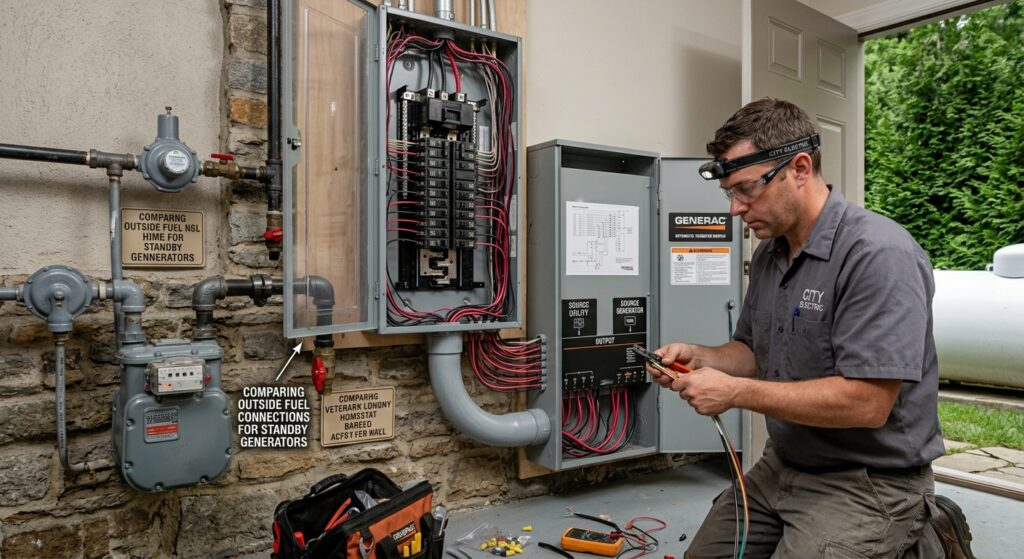
If you’re planning a generator installation, understanding how does a transfer switch work is essential before you get anywhere near wiring or permits. A transfer switch isn’t optional hardware. It’s the single component that makes running a generator into your home’s wiring safe in the first place. Without one, connecting a generator directly to your home’s electrical system risks a phenomenon called backfeed. Backfeed can damage your generator and your home’s wiring. Worse, it can electrocute utility workers trying to restore power on what they believe is a dead line.
This guide walks through exactly what a transfer switch does and how it physically works. It also explains why it’s treated as a non-negotiable safety requirement rather than a nice-to-have. For the practical next steps, see our guides on manual vs automatic transfer switches and permits and code requirements for generator installation.
What a Transfer Switch Actually Does
At its core, a transfer switch is an electrical device. It’s installed between your utility meter, your home’s main breaker panel, and your generator. Its job is simple to describe but critical in function: it makes sure your home’s wiring is connected to only one power source at a time. That means either the utility grid or the generator, never both simultaneously.
That single job solves two distinct problems at once. First, it protects your home’s circuits and your generator from electrical damage. That damage can happen if two power sources try to feed the same wires at once. Second, and more importantly for safety, it prevents backfeed. Backfeed means electricity flowing backward out of your home and into the utility lines outside. This can be lethal for line workers who assume a downed grid is fully de-energized during a repair.
How Does a Transfer Switch Work, Step by Step?
To understand how a transfer switch works in practice, it helps to walk through what happens during a typical outage:
- The utility grid goes down. Your home loses power. If you have an automatic system, a sensor connected to the transfer switch detects the interruption within seconds.
- The switch disconnects your home from the grid. This is the critical safety step. Before any generator power is ever allowed into your home’s wiring, the transfer switch physically breaks the connection to the incoming utility line. This is what makes backfeed impossible: your house is never tied to both sources at the same time.
- The generator starts (automatically or manually). With an automatic standby system, the generator’s engine starts on its own once the switch signals a loss of power. It typically reaches full output within 10–20 seconds. With a manual system, the homeowner starts the generator and then manually operates the switch.
- The switch connects the generator to the selected circuits. Depending on the type of switch installed, this could mean powering the entire home (whole-house switches). Or it could mean powering just a pre-selected set of essential circuits (partial-home switches), such as the refrigerator, well pump, furnace blower, and a few outlets.
- Power is restored from the grid. Once utility service returns, the switch detects it automatically, after a short stabilization delay. Or, with a manual system, it waits for the homeowner to notice. Either way, it reverses the whole process. It disconnects the generator first, then reconnects the home to the grid.
That disconnect-before-connect sequence, repeated in both directions, is the entire mechanical principle behind how a transfer switch works. This holds true whether it’s a $200 manual switch or a $2,000 fully automatic one.
Manual vs. Automatic: Two Ways of Performing the Same Job
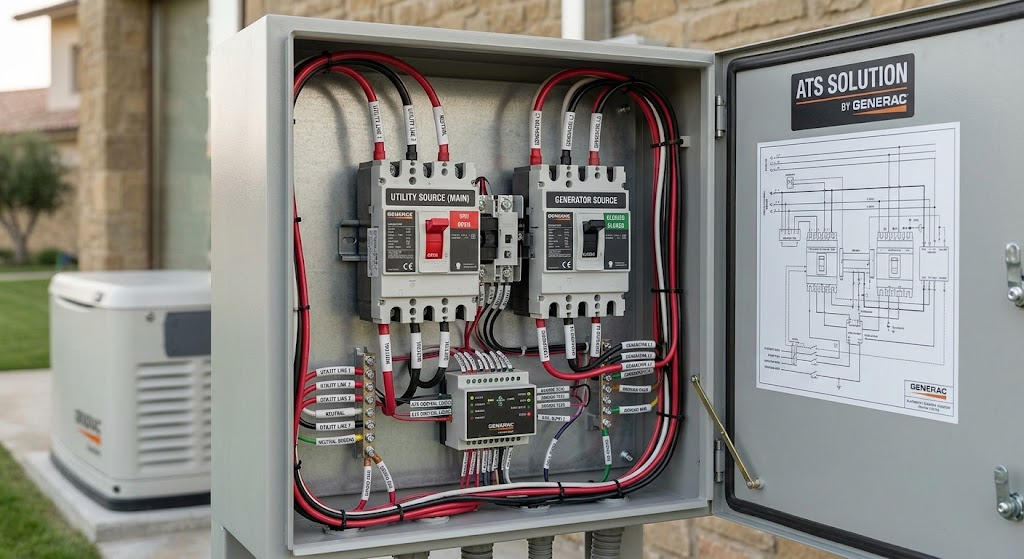
Both manual and automatic transfer switches perform the exact function described above. The difference is purely in who — or what — triggers the switching action.
A manual transfer switch requires the homeowner to physically flip a set of switches or a rotary dial. This usually happens after starting a portable generator outside and plugging it into an inlet box. It’s less expensive and simpler to install. But it means someone has to be home and available to operate it during an outage, which can be a real limitation overnight or while traveling.
An automatic transfer switch is wired directly to a standby generator and monitors utility power continuously. When it detects an outage, it starts the generator and switches over without any human involvement. It also does the reverse automatically once utility power stabilizes again. This is standard on whole-house standby systems. It’s what allows a generator to keep a home powered even when nobody is there to operate anything manually.
We cover the practical trade-offs between the two — cost, convenience, and which situations call for each — in our dedicated manual vs. automatic transfer switch comparison.
Why You Can’t Just Skip the Transfer Switch
It’s technically possible to plug a portable generator into a wall outlet using an improvised double-male cord, sometimes called a “suicide cord.” This bypasses a transfer switch entirely. It’s illegal in most jurisdictions and genuinely dangerous, for a specific reason worth understanding rather than just accepting. Without a transfer switch physically isolating your home from the grid, electricity from your generator can travel backward through your home’s wiring. From there it can flow out through the meter and onto the utility line outside. That line may have utility crews actively working on it, believing it’s de-energized because the neighborhood transformer is down.
This isn’t a rare hypothetical. Backfeed incidents are a documented cause of injury to utility linemen during storm restoration work. That risk is exactly why electrical codes require a transfer switch, or an equivalent interlock device, for any generator connection beyond a simple portable-appliance extension cord.
Where a Transfer Switch Fits in Your Installation
A transfer switch is typically installed right next to your home’s main breaker panel. The installation itself, along with the required permits and inspection, is generally handled by a licensed electrician. This is partly because of the complexity of tying into your home’s main electrical feed. It’s also because most jurisdictions require it for code compliance and insurance purposes. If you’re budgeting for a full setup, our guide on how much a whole-house generator costs installed breaks down where transfer switch installation typically falls within the total project cost.
Final Thoughts
Understanding how a transfer switch works comes down to one core idea: it guarantees your home is connected to exactly one power source at a time. That disconnect-before-connect sequence is what prevents backfeed, protects your equipment, and keeps utility workers safe during outages. Whether you go with a manual switch you operate yourself or a fully automatic system tied to a standby generator, the underlying safety principle is identical. It’s the reason a transfer switch is treated as a required part of any generator installation, not an optional accessory.