
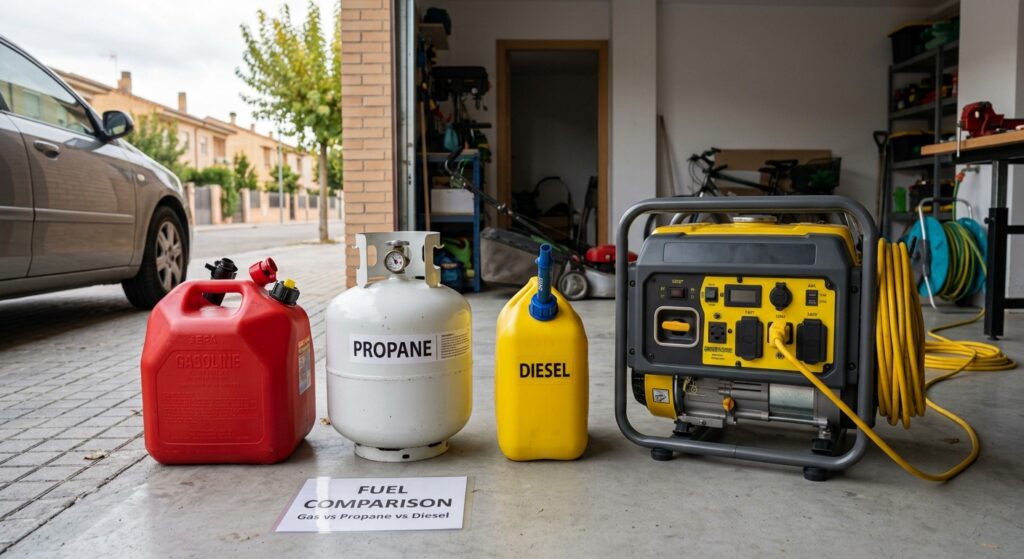
Picking between a gas vs propane vs diesel generator is a decision that affects your generator experience far more than most buyers expect — it determines how long you can store fuel safely, how the unit starts in cold weather, and how much you’ll actually spend per hour of runtime during a real outage.
This guide compares all three fuel types head-to-head on cost, storage life, cold-weather reliability, and availability during widespread emergencies, including the two details that matter most once you’re actually relying on the generator: what happens to unused fuel sitting in your garage for a year, and what a real cost-per-kWh comparison looks like once you run the numbers.
Quick Answer
In the gas vs propane vs diesel generator comparison, gasoline offers the lowest upfront cost and widest availability but the shortest safe storage life. Propane stores indefinitely and burns cleaner, at a modest efficiency cost. Diesel delivers the best fuel efficiency and engine longevity, but at a higher upfront generator cost.
Gasoline Generators
Gasoline is the default fuel for most portable generators because it’s cheap, widely available, and every gas station carries it. That convenience comes with two real drawbacks: gasoline degrades within 30–60 days without a stabilizer, and it’s the fuel most likely to be scarce exactly when you need it — during widespread outages, gas stations frequently run dry within hours as demand spikes.
- Typical cost: $3.00–$4.00/gallon (varies by region and season)
- Storage life: 30–60 days untreated; 1–2 years with fuel stabilizer, in a sealed, approved container
- Cold weather starting: Generally reliable down to around 0°F; below that, cold-start issues become more common
- Availability during emergencies: Poor — often the first fuel to run out at local stations during a widespread outage
Propane Generators
Propane has become increasingly popular for home backup because of one major advantage: it doesn’t degrade in storage. A sealed propane tank can sit for years and still work exactly as expected, which makes it the fuel of choice for generators that only get used once or twice a year.
- Typical cost: $2.50–$3.50/gallon equivalent, though efficiency is roughly 10–15% lower than gasoline per gallon
- Storage life: Effectively indefinite when stored in an approved tank
- Cold weather starting: Excellent — propane doesn’t thicken or gel in cold temperatures the way diesel can
- Availability during emergencies: Better than gasoline in many regions, since propane suppliers and larger tanks aren’t subject to the same station-level panic buying
Diesel Generators
Diesel generators are less common in the residential portable segment but dominate larger standby and commercial-grade units. Diesel engines are simpler mechanically (no spark plugs), tend to last longer under heavy use, and burn fuel more efficiently per kilowatt-hour than gasoline.
- Typical cost: $3.50–$4.50/gallon, but delivers more energy per gallon than gasoline
- Storage life: 6–12 months untreated; up to 2 years with a diesel-specific stabilizer
- Cold weather starting: Can be problematic below 20°F without a block heater or winter-blend fuel, due to fuel gelling
- Availability during emergencies: Moderate — less prone to panic buying than gasoline, but less universally available than either gas or propane
Gas vs Propane vs Diesel Generator: Full Comparison Table
| Factor | Gasoline | Propane | Diesel |
|---|---|---|---|
| Upfront generator cost | Lowest | Low-moderate | Highest |
| Fuel cost per gallon | $3.00–$4.00 | $2.50–$3.50 (equiv.) | $3.50–$4.50 |
| Storage life | 30–60 days (1–2 yrs treated) | Indefinite | 6–12 months (up to 2 yrs treated) |
| Cold-weather starting | Good above 0°F | Excellent | Weak below 20°F untreated |
| Availability in emergencies | Poor | Good | Moderate |
| Engine lifespan | Moderate | Moderate-good | Best |
Real Cost Per kWh: Running the Numbers
Sticker price per gallon is misleading on its own, since each fuel delivers a different amount of usable energy. Based on typical mid-size generator efficiency figures:
- Gasoline: roughly $0.35–$0.45 per kWh generated
- Propane: roughly $0.40–$0.50 per kWh generated (slightly higher due to lower energy density per gallon)
- Diesel: roughly $0.30–$0.38 per kWh generated, the most efficient of the three despite diesel’s higher price per gallon
Over a 3-day outage running a 5,000-watt load 10 hours a day, that translates to roughly $52–$68 in gasoline, $60–$75 in propane, and $45–$57 in diesel — a gap that becomes meaningful for anyone running a generator frequently rather than a few times a year.
What Happens to Fuel Sitting Unused for a Year
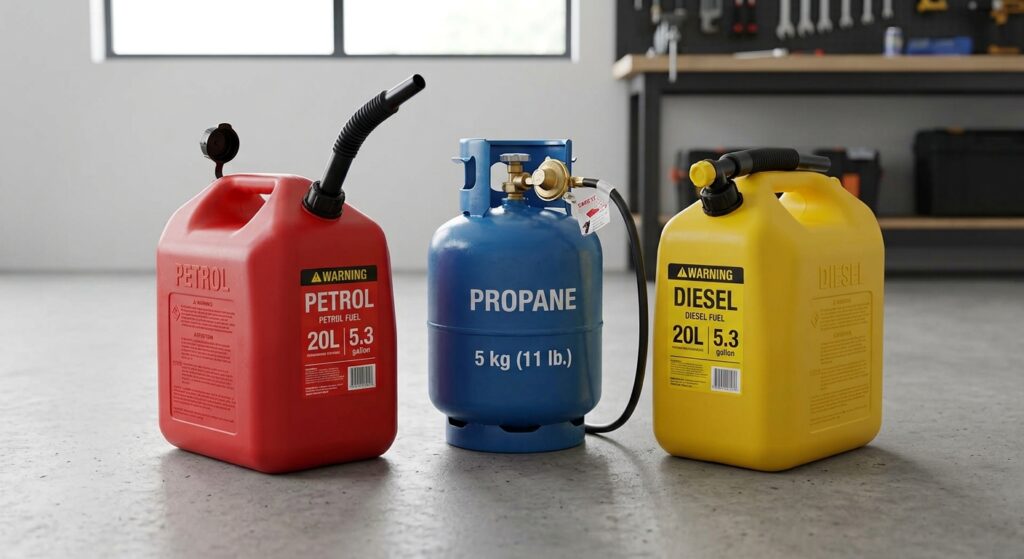
This is the detail that catches most homeowners off guard. A generator that worked perfectly last season can fail to start the next, purely because of what happened to the fuel in the meantime:
- Gasoline left untreated for a year will almost certainly cause starting problems — the fuel oxidizes, leaves gum deposits in the carburetor, and can require a full carburetor cleaning to fix.
- Propane stored in a sealed tank is essentially unaffected by a year of storage, which is the single biggest reason many homeowners switch to propane for infrequently used backup generators.
- Diesel develops some degradation and can support microbial growth in humid climates if untreated, but a stabilizer extends viability meaningfully and the risk is lower than with gasoline.
If your generator is likely to sit unused for long stretches between storms, this factor alone can outweigh the fuel cost differences above.
Which Fuel Fits Your Situation?
Choose gasoline if: you already have a gasoline generator, use it fairly regularly (at least every 1–2 months), and prioritize the lowest upfront cost.
Choose propane if: the generator will sit unused for months at a time between outages, you want the longest safe storage life, or you already have a propane tank on the property for a grill or standby generator.
Choose diesel if: you’re buying a larger standby or heavy-duty unit, run the generator for extended hours regularly, and want the best long-term fuel efficiency and engine durability — but confirm cold-weather performance if you live somewhere winters regularly drop below 20°F.
For help deciding how much power you need before choosing a fuel type, see our guide on how to choose the right generator size, and for the portable-vs-standby decision that often drives fuel choice, see our portable vs standby generator comparison.
3 Mistakes Homeowners Make Choosing a Generator Fuel
- Storing gasoline for months without a stabilizer, then being surprised when the generator won’t start. Adding a stabilizer at fill-up and rotating fuel every few months prevents most of these failures.
- Assuming diesel is always more efficient in practice. It’s true on paper, but a diesel generator that struggles to cold-start in winter without a block heater can end up less reliable in exactly the scenario it was bought for.
- Not checking local fire code storage limits. Most jurisdictions cap how much gasoline can be legally stored on a residential property, typically around 25 gallons in approved containers — details vary by state and are worth confirming, and general safe fuel storage practices are outlined by the U.S. Fire Administration’s fuel storage guidance.
Frequently Asked Questions
Which fuel is cheapest to run a generator on?
Diesel typically offers the lowest cost per kWh generated despite its higher price per gallon, due to better fuel efficiency, though gasoline has a lower barrier to entry for smaller portable units.
Can I convert a gasoline generator to run on propane?
Yes, dual-fuel conversion kits exist for many popular gasoline generator models, though they typically reduce output by around 10–15% compared to running on gasoline.
Which fuel is safest to store long-term?
Propane, by a significant margin — a sealed tank has essentially no shelf-life limit compared to gasoline’s 30–60 days untreated.
Does cold weather affect generator fuel choice?
Yes. Propane performs best in cold conditions, gasoline is generally reliable down to around 0°F, and diesel can struggle below 20°F without a block heater or winter-blend fuel.
Bottom Line
There’s no universal winner in the gas vs propane vs diesel generator comparison — the right fuel depends on how often you’ll use the generator, how long it needs to sit in storage between uses, and your local climate. For occasional use with long storage gaps, propane’s shelf life is hard to beat; for frequent or heavy-duty use, diesel’s efficiency pays off over time; and for lowest upfront cost with regular use, gasoline remains a solid, practical choice.