
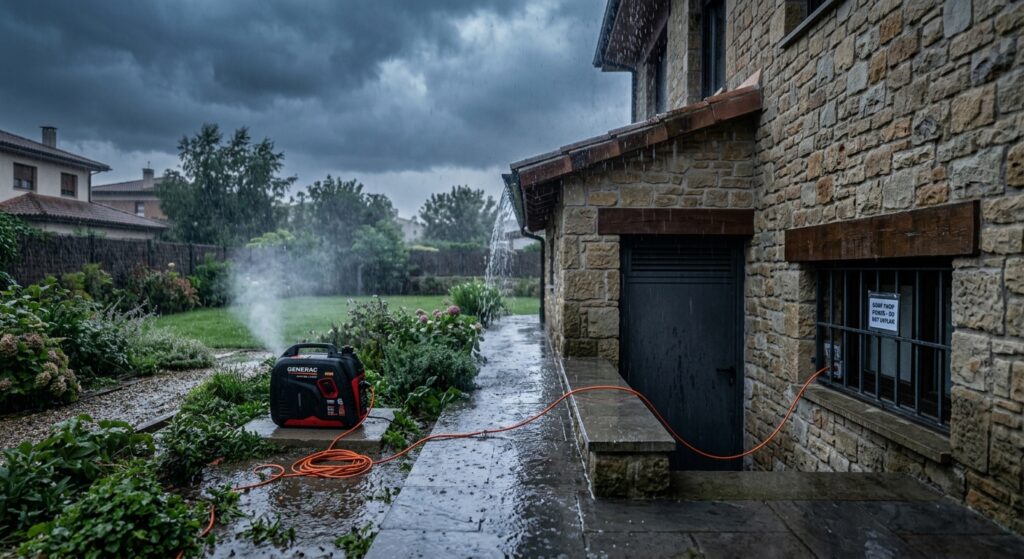
A basement flood often starts with a power outage. Storms knock out the grid, and your pump stops at the worst possible moment. A generator for sump pump backup keeps the water moving until power returns. In this guide, you will learn how many watts you need, which portable models fit most homes, and how to set one up safely.
Why a Generator for Sump Pump Backup Makes Sense
Heavy rain and power cuts usually arrive together. That is exactly when your pump works hardest. As a result, a dry basement depends on electricity at the wrong moment.
A battery backup can help, but it has limits. For example, a battery can run out within a few hours when water keeps flowing in. A portable generator, however, keeps going as long as you have fuel. It can also power lights or a refrigerator. If you want to compare fuel-free options first, see our guide to portable power stations under $500.
How Many Watts Does a Sump Pump Need?
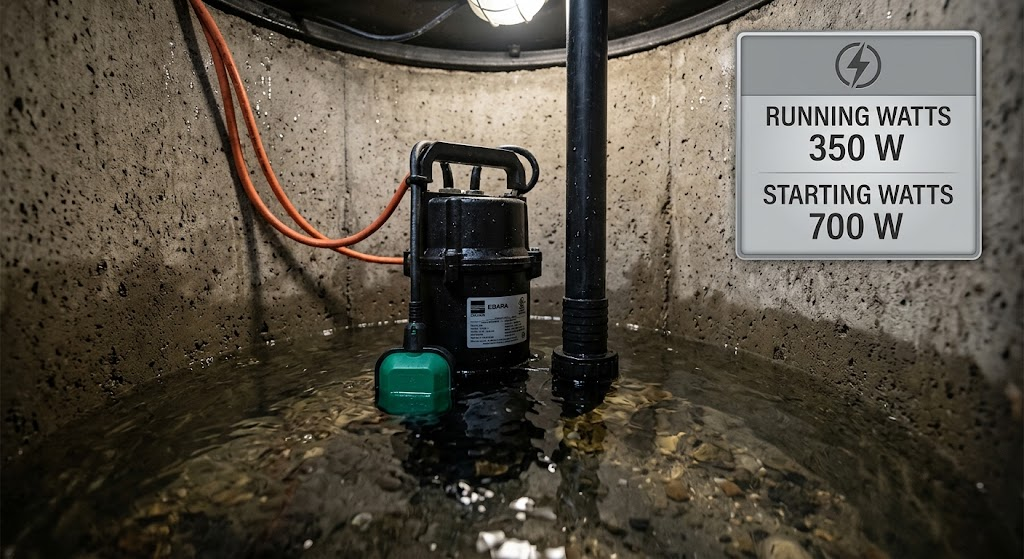
Motors need extra power to start. Therefore, you must check two numbers: running watts and starting watts.
Most home pumps need roughly 600 to 1,500 running watts. At startup, they can draw two to three times that amount. For instance, a 1/3 HP pump often needs about 1,300 starting watts. A 1/2 HP pump can need 2,100 or more.
Check the label on your pump to be sure. A generator for sump pump duty must cover that startup surge, not just the running number. Then add the watts of anything else you plan to run, such as a few lights or a refrigerator. Finally, add a safety margin of about 20 percent. Our guide on how to choose the right generator size explains this math step by step.
(Aquí va la imagen secundaria)
What to Look for in a Generator for Sump Pump Use
Not every portable unit suits this job. Keep these points in mind:
- Starting watts: Choose a unit that covers your pump’s surge with room to spare.
- Runtime: Look for a large tank or dual fuel, because long storms can last for days.
- CO shutoff: The U.S. Consumer Product Safety Commission urges buyers to look for a carbon monoxide shut-off feature.
- Noise: A quiet inverter model keeps your neighbors happy. Our list of best quiet generators for residential neighborhoods has more options.
- Easy starting: This matters if the outage hits at night or while you are away.
Best Portable Generators for a Sump Pump
The best generator for sump pump duty depends on your pump size. The two models below cover most homes. Prices change often, so check current listings before you buy.
Honda EU2200i: Best for Small Pumps
The Honda EU2200i delivers 2,200 starting watts and 1,800 running watts, according to Honda. That is enough for many 1/3 HP pumps. In addition, its CO-Minder sensor shuts the unit down if carbon monoxide builds up nearby.
The tank holds 0.95 gallons. It runs about 3.2 hours at rated load and up to 8.1 hours at one-quarter load. Because a sump pump cycles on and off, your real runtime is usually longer. The unit is also very quiet, at 48 to 57 dBA, and it weighs about 47 pounds.
However, it has some drawbacks. It costs more than open-frame models, since Honda lists it at $1,199. It also has a recoil start only. Finally, it may be too small for a 1/2 HP pump.
Champion 4375/3500 Dual Fuel: Best for Bigger Pumps
If your pump is larger, step up in size. The Champion 4375/3500 dual fuel generator produces 4,375 starting watts and 3,500 running watts on gasoline. On propane, output drops to about 3,950 starting watts and 3,150 running watts.
Moreover, dual fuel gives you choices. Propane stores well, and gasoline is easy to find before a storm. The 4.7-gallon tank runs roughly 12 to 14 hours at half load on gasoline, depending on the version. Many versions include CO Shield shutoff, so confirm this feature before you order.
On the downside, it weighs more than 100 pounds. It is also louder, at about 68 dBA. For more fuel-flexible choices, read our list of best dual fuel generators.
Portable Power Station: Best Fuel-Free Option
A large power station needs no fuel, makes no fumes, and runs quietly. It also needs no outdoor setup. However, its battery limits runtime during long outages. In addition, you must check the surge rating against your pump. Smaller units under $500 may not start a larger pump.
How to Set Up a Generator for Sump Pump Backup Safely
Safety matters more than speed here. Carbon monoxide can kill within minutes, and storms make mistakes more likely. Follow these rules:
- Run it outside only. Never use a generator in a garage, basement, crawlspace, or shed, even with the doors open.
- Keep your distance. Place it at least 20 feet from your home, with the exhaust pointed away from windows, doors, and vents.
- Keep it dry. Ready.gov warns that touching a wet generator can cause electric shock. Follow your manual for a safe, covered setup.
- Use the right cord. Choose a heavy-duty outdoor extension cord rated for your pump’s amps.
- Refuel with care. Let the generator cool first, and store gasoline in approved containers. Our guide on how to store gasoline safely for generator use covers the details.
- Never backfeed. Do not plug a generator into a wall outlet. OSHA’s fact sheet explains the shock and electrocution risks.
Also, install battery-operated carbon monoxide alarms inside your home. For more detail, read our carbon monoxide safety rules for generator owners and our guide to running a portable generator safely during a power outage.
If your pump is hardwired, a plug-in cord will not work. In that case, hire a licensed electrician to install a transfer switch. Our guide to the best transfer switch kits for portable generators explains your options.
Test Your Setup Before the Storm
Do not wait for an outage to find problems with your generator for sump pump setup. First, run the generator under load and plug in your pump. Next, pour a bucket of water into the pit to confirm the pump starts and drains. Then measure the cord run, so you know it reaches without strain.
Also, keep fresh fuel on hand. Add a fuel stabilizer if it will sit for months. Finally, follow a regular schedule. Our advice on how often to run your generator and our storm season maintenance checklist will help you stay ready.
To plan your budget, see how much a portable generator costs to run per day. Since a pump runs only part of the time, your actual cost will usually be lower.
Final Thoughts
A dependable generator for sump pump protection costs far less than flood repairs. Start by checking your pump’s starting watts. Then choose a unit with enough surge capacity, CO shutoff, and runtime for a long storm. Finally, set it up outdoors, test it monthly, and keep fuel on hand. With those steps, your basement stays dry when the grid goes down.